Irish Grid Monthly: May 2026
In case you missed it, we had a baby in April and May was our first full month with a newborn. As we try to navigate and enjoy the first-time parents experience, please bear with us if we've missed anything in this issue. If you spotted any mistakes and/or want to see a particular topic covered, please send us a message at hello@greencollective.io.
TL;DR
- High renewables share for a May month: In May 2026, 38% of all-island demand was met by renewable generation, the highest we've seen for a May month, despite a nearly 4% year-on-year increase in demand.
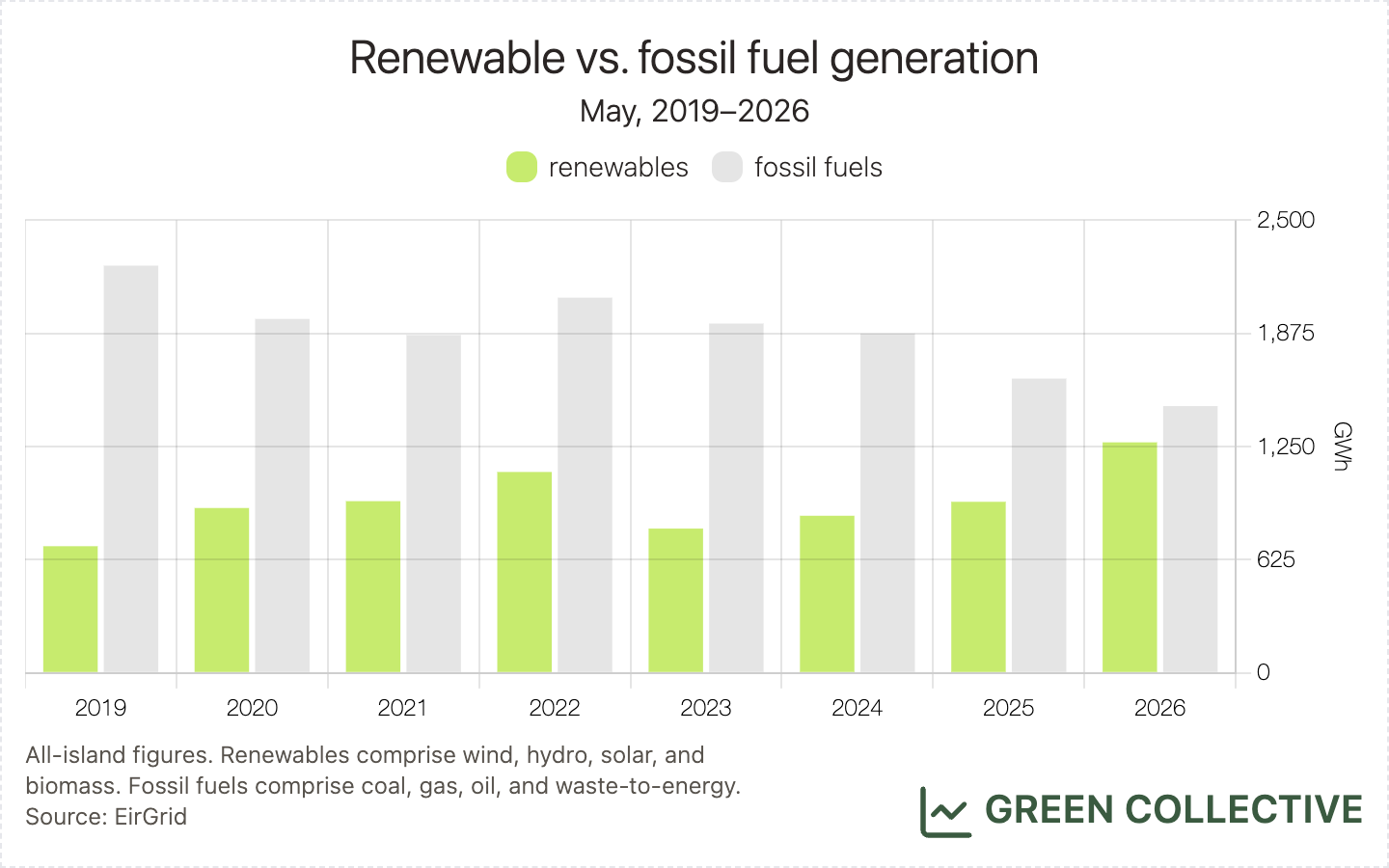
- Smallest gap between renewables and fossil fuels for a May month: While the 3-month streak of renewable generation exceeding fossil fuels has come to an end, it's important to note we usually expect fossil fuels to be much higher than renewables in May. However, the gap was only 6% last month.
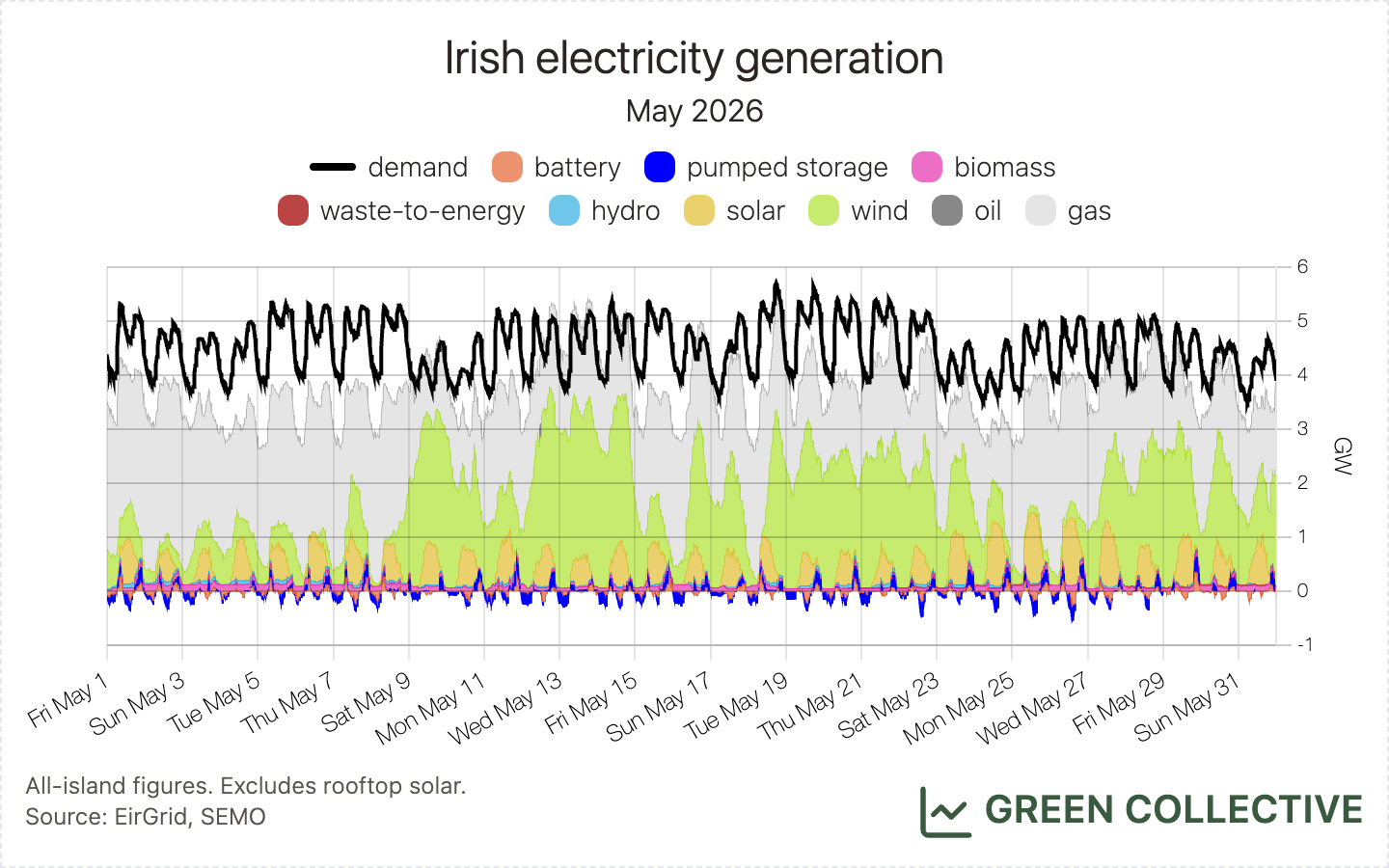
- All major solar records were broken last month: Among the new solar records, the one that best represents the amount of solar on the Irish grid is the instantaneous share of electricity demand met by solar farms. On Sunday May 24, that share reached more than 32% at all-island level. If we look at the Republic of Ireland alone, this reached an even more incredible 37%.
- Transmission constraints were the main cause behind wind dispatch down in May: We estimate dispatch down rate was 18% for wind and 13% for solar. The majority of wind dispatch down was due to transmission constraints. For solar, more dispatch down was attributed to curtailment, but we do see more constraints for solar farms close to Dublin.
High-level stats
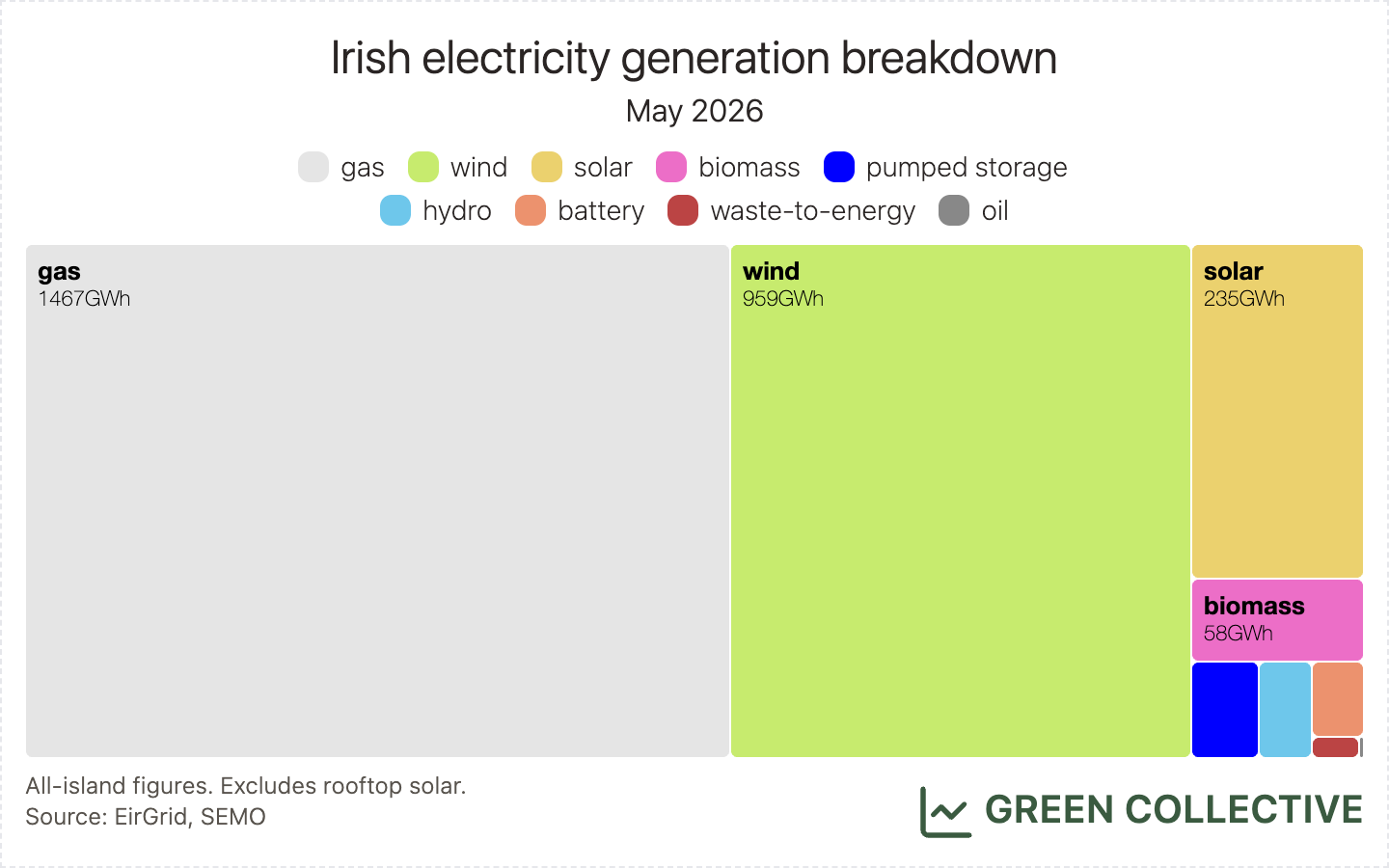
- Electricity demand on the island of Ireland during May 2026 totalled 3353.9GWh, a 3.6% year-on-year increase from May 2025. This was the highest demand ever seen in a May month.
- Renewable generation totalled 1272.9GWh, equivalent to 38% of the island's electricity demand. Both figures are the highest ever for a May month. This is only the second time renewable generation has exceeded 1TWh in a May month.
- Fossil fuel generation totalled 1471.4GWh, equivalent to 43.9% of the island's electricity demand. Both figures are the lowest ever for a May month, and by some distance: just last year, 50% of May's electricity demand was supplied by fossil fuels.
- Discharging storage totalled 42.3GWh. This, unfortunately, is almost exactly the same figure as May 2025 meaning growth here is flat.
- Net imports totalled 577GWh, equivalent to 17.2% of the island's electricity demand. Both figures are the second-highest in a May month, although significantly down year-on-year from May 2025's record import figures.
Regular readers may recall that from February through April we saw an unprecedented three month-long streak on the Irish grid in which renewable generation each month exceeded that of fossil fuels. That streak has come to an end but this should come as no surprise: wind still makes up the vast majority of Irish renewable generation and summer is the least windy time of year. However, the gap between fossil fuels and renewables has never been so close for a May month: there were just six percentage points between fossil fuels and renewables; add in discharging storage and that figure drops to 4.6%. As recently as 2019, fossil fuels supplied fully 75% of May's electricity demand; the trend in the chart below could hardly be much clearer.
Records
It's summer, electricity demand is lower, solar capacity has expanded, and every single major solar record was broken:
- Highest instantaneous output: 1324.75MW, May 25
- Largest one-day total: 12795.50MWh, May 25
- Highest one-day percentage of electricity demand met: 12.3%, May 24
- Highest instantaneous share of electricity demand: 32.3%, May 24 (in the ROI, this reached an incredible 37% – we were happy to help Solar Ireland get the message out via the Irish Times)
Emissions
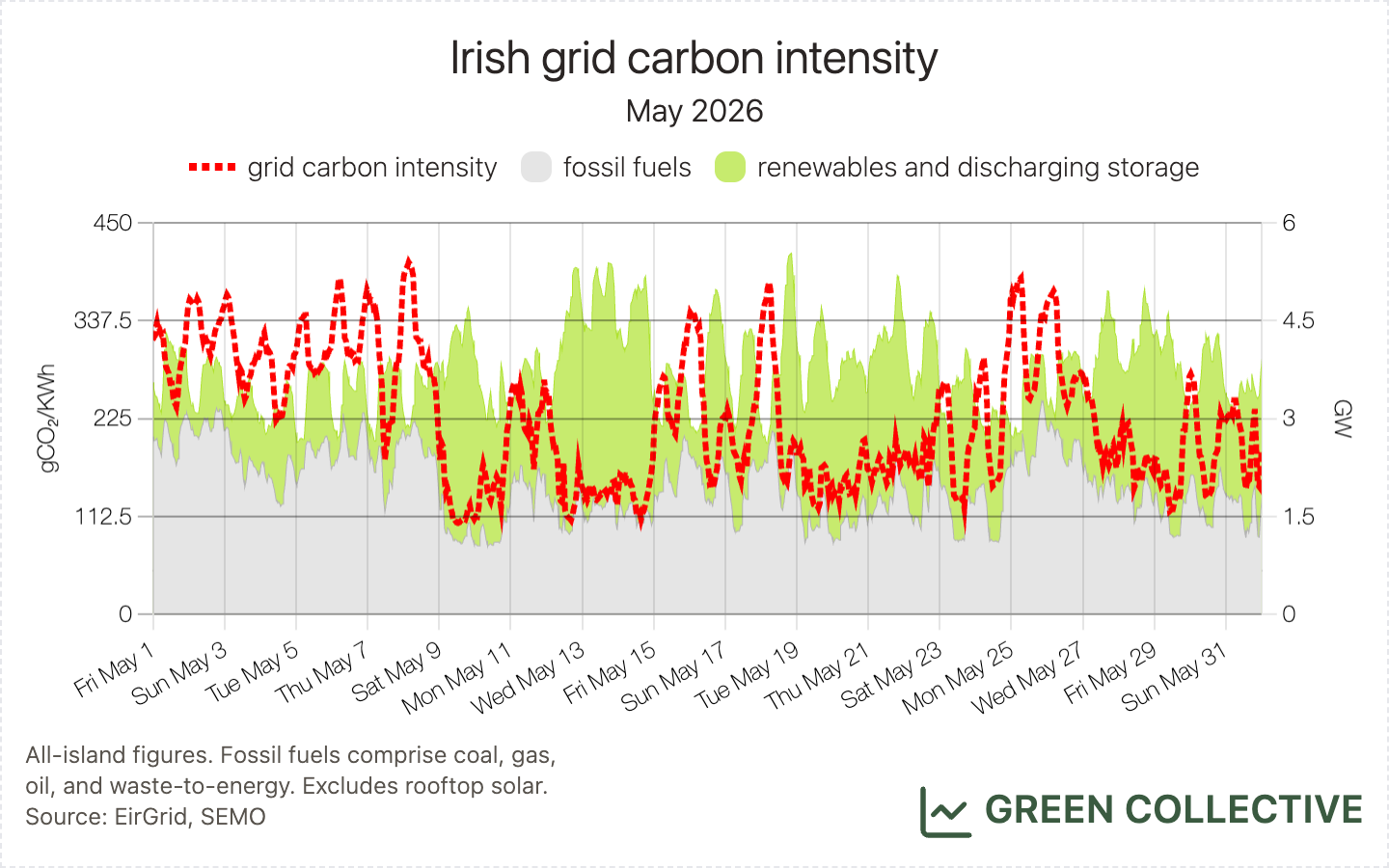
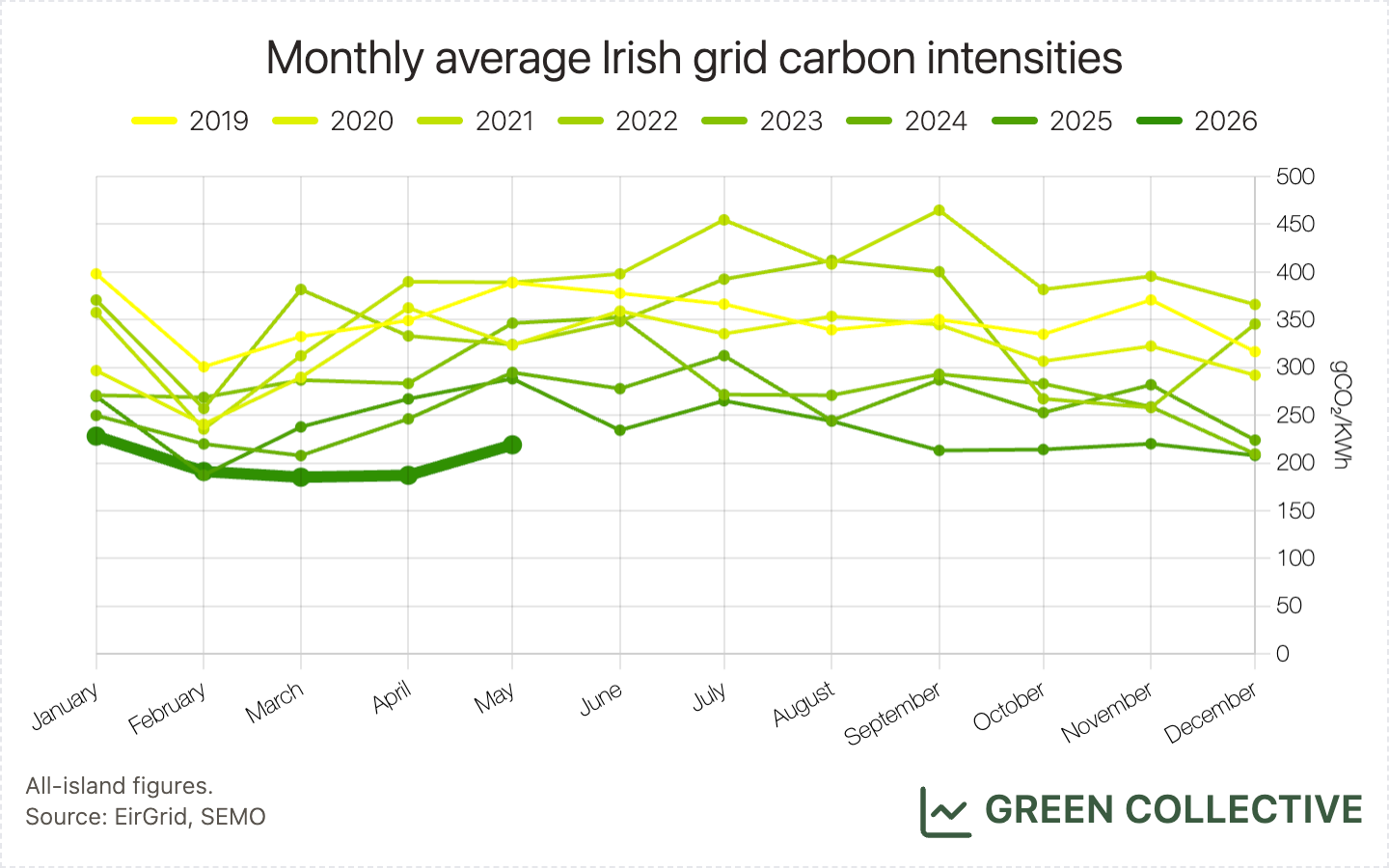
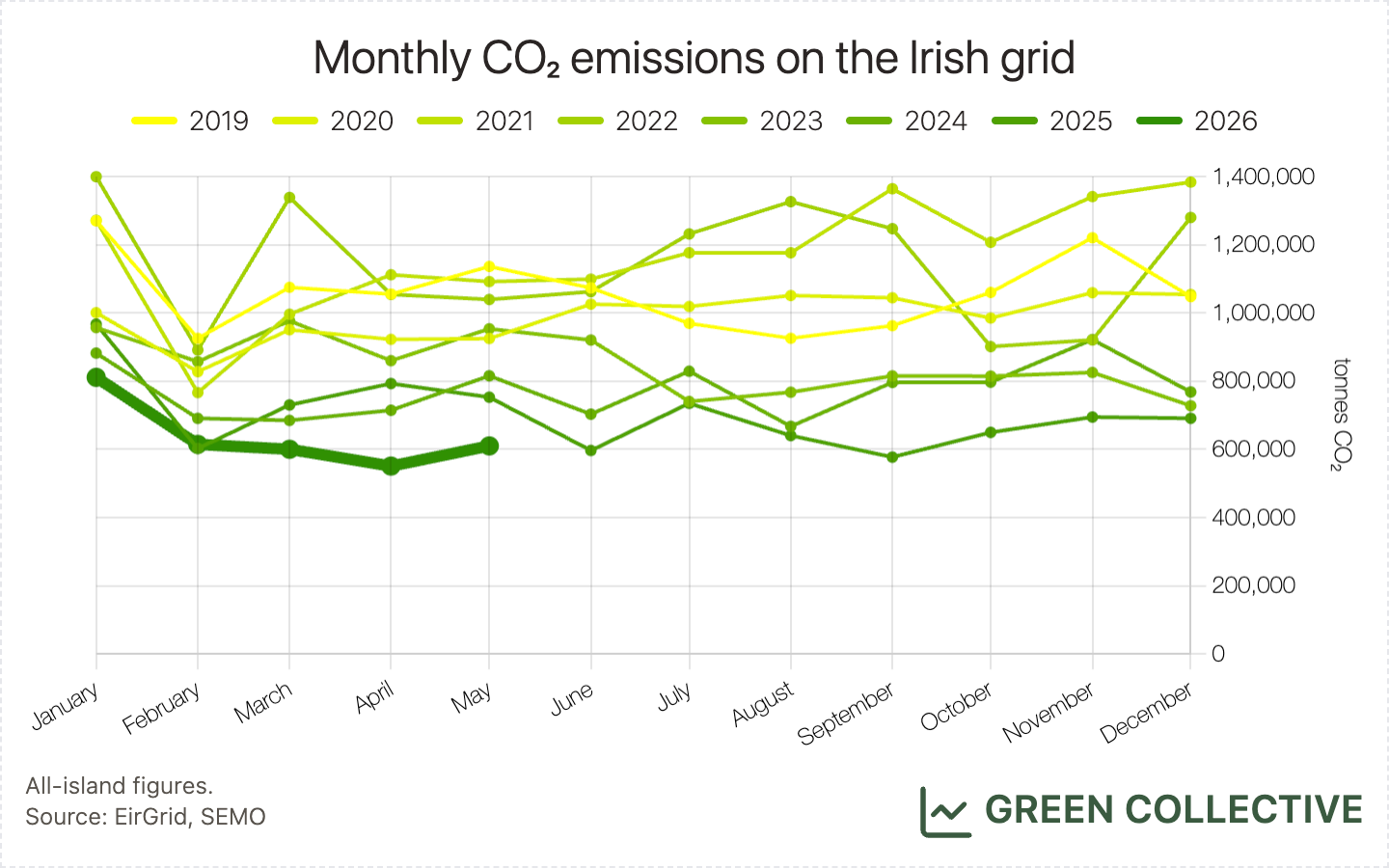
We estimate that during May 2026 the Irish grid emitted approximately 610,000 tonnes of CO₂, ranging, for each kWh of electricity generated, between 105g and 405g of CO₂ for an average grid carbon intensity of 219gCO₂/KWh. This was both the lowest volume of CO₂ and lowest monthly average grid carbon intensity for a May month by some distance, well below May 2025's 753,000t and 288gCO₂/KWh. This was also the lowest monthly average grid carbon intensity yet seen in any summer month (May-August).
County-level analysis
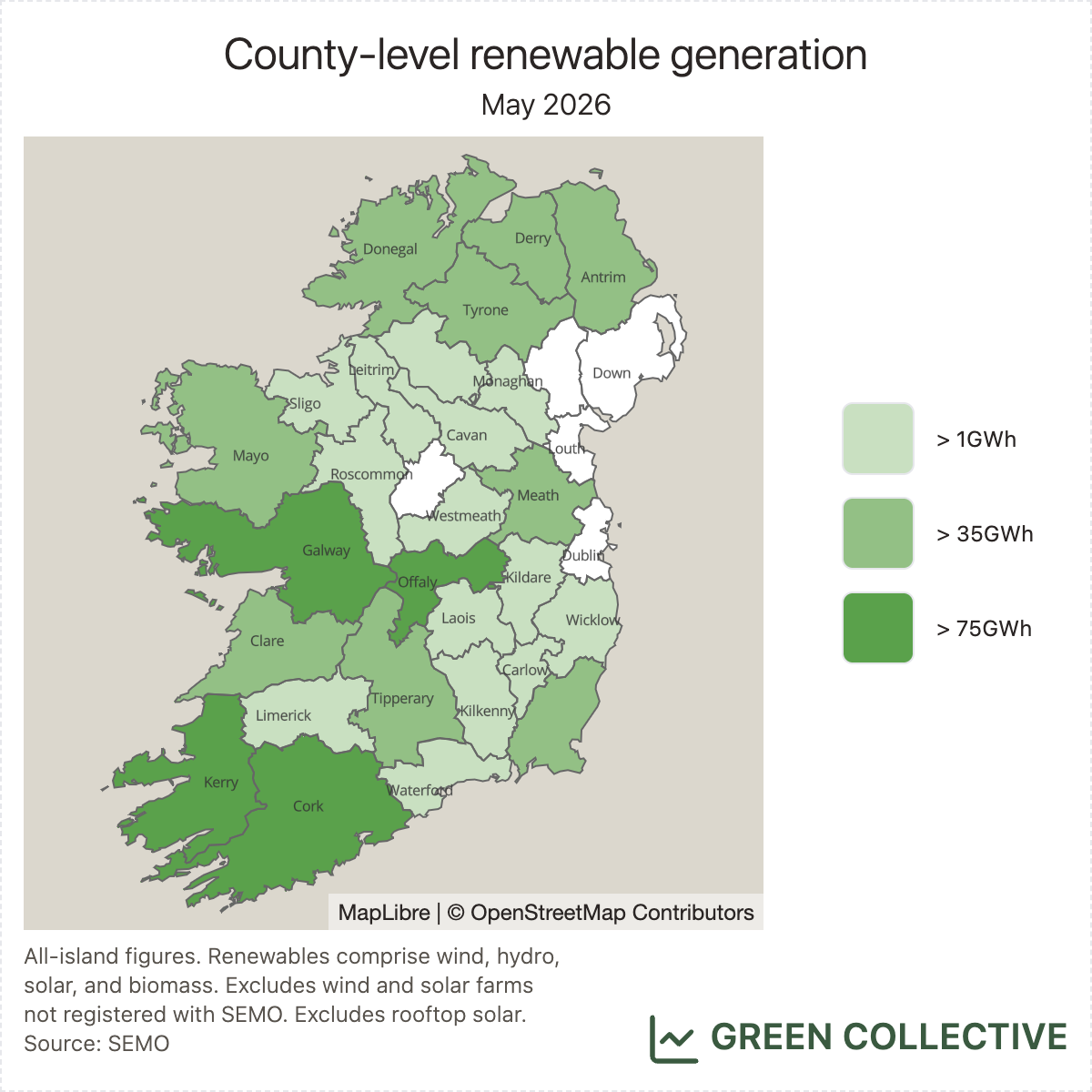
The top five renewable-producing counties during May 2026:
- Offaly
- Kerry
- Cork
- Galway
- Meath
Offaly assumes top spot this month. While wind generation is lower in summer across the board, the large biomass plant at Edenderry keeps on burning. In fact, Offaly was the only county this month to exceed 100GWh of renewable generation.
However, most notable this month is Meath's appearance at #5: it's solar season, and Meath is currently home to approximately 30% of the island's solar generation. Looking back through our figures, Meath's been appearing periodically as a top five renewable county in the summer since 2024 – in July 2024 it even reached #3. The shifts in county rankings through the changing seasons (Clare's Ardnacrusha is another example) is precisely why we reconfigured this section of our newsletter earlier this year.
Thank you for reading! The rest of the newsletter is available to paying subscribers. We go into more details on our dispatch down estimates and cover more highlights for wind, solar, storage, and fossil fuels respectively. You can upgrade to a paid subscription to access all our analysis.