Irish Grid Monthly: February 2026
TL;DR
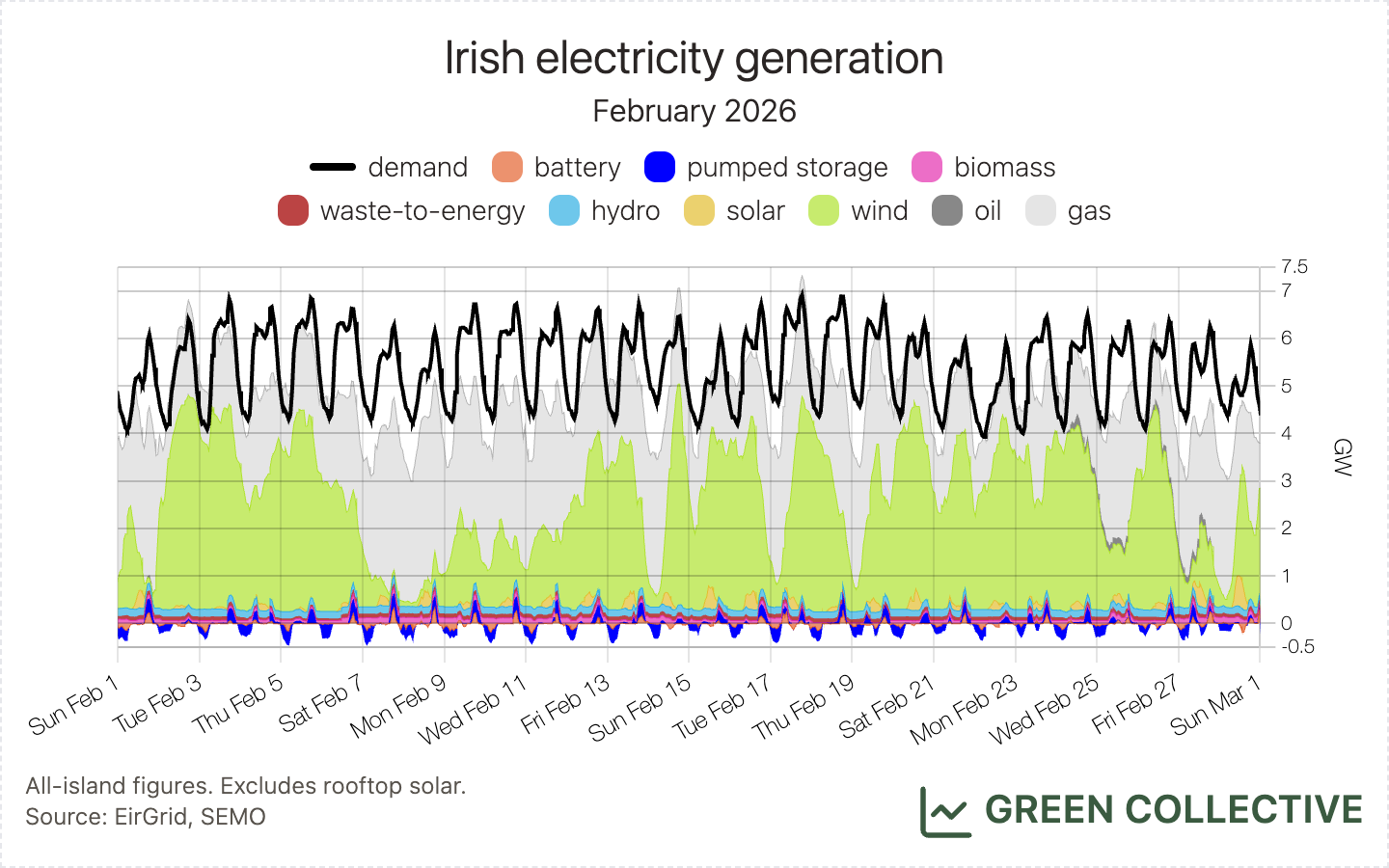
- Wind output record: Early in the evening of Saturday, February 14, the island recorded a new all-time record for wind output: 4686MW, equivalent to 72% of electricity demand at the time.
- Solar is already picking up: While solar generation in February 2026 fell approximately 8% from February 2025, on February 28, output reached almost 650MW – equivalent to approximately 13% of the island's entire demand around noon. These were record numbers in the summer of 2024 which, less than two years later, we're now seeing in winter.
- Clare made it to top five renewable-producing counties: Its promotion to the top five last month is entirely due to Ardnacrusha which, presumably thanks to winter rainfall, was the #2 renewable-producing plant on the island, behind only Oweninny in County Mayo, the island's largest wind farm. Not bad as Ardnacrusha enters its second century of operation!
- Hourly large energy users demand data released by the CSO shows the sector's metered electricity consumption remains extremely flat: Data centre demand flexibility has been a hot topic over the last year, if not longer, but it's unclear whether the demand concentrated in Dublin/Meath has the potential to respond to fluctuating grid carbon intensity and be flexible.
High-level stats
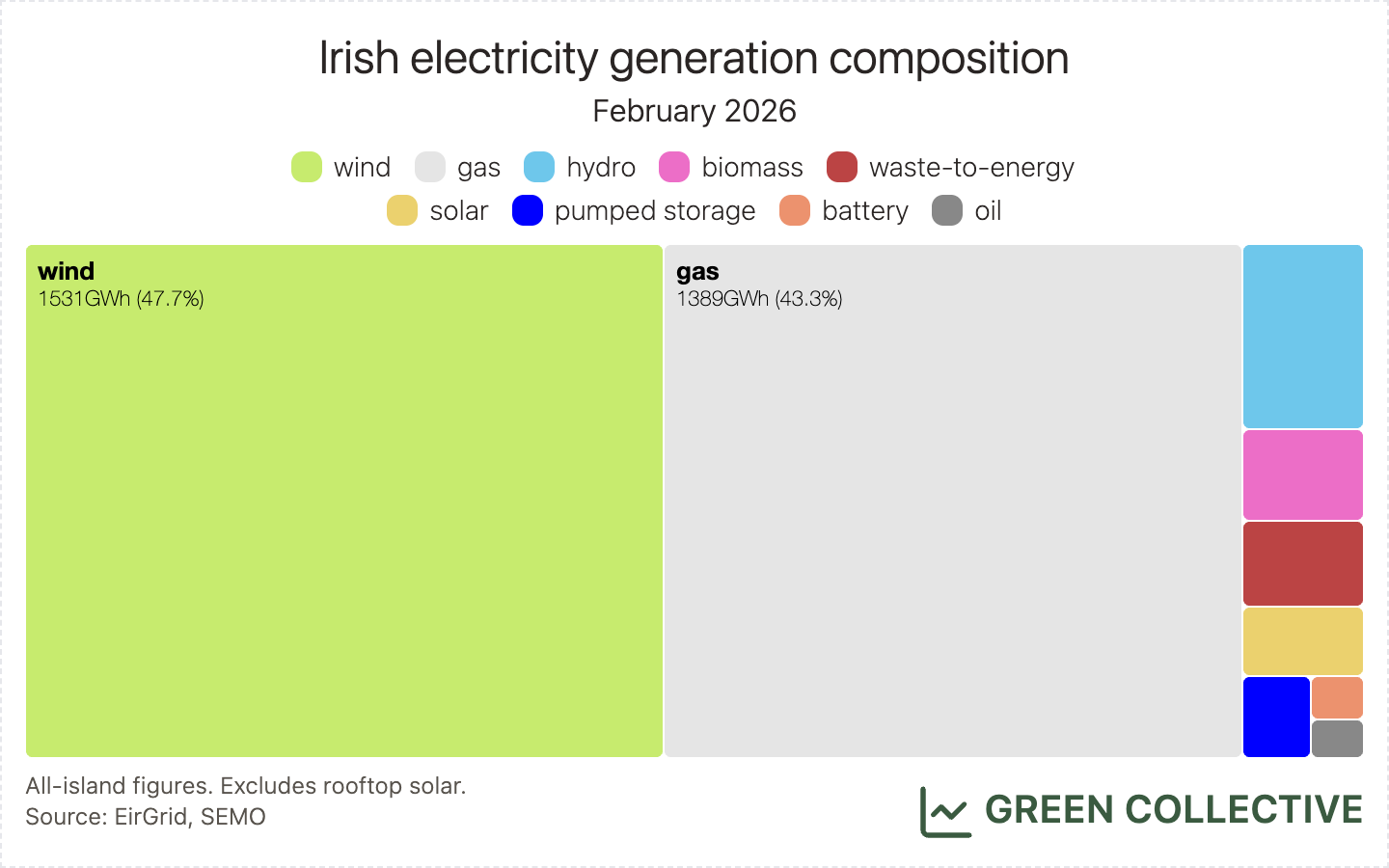
This is how all-island electricity demand was met in February 2026:
- Renewable generation equalled 47.6% of demand.
- Fossil fuel generation equalled 39.9% of demand.
- Pumped storage and discharging batteries equalled 1% of demand.
- Net imports equalled 11.5% of demand.
Renewable generation and storage
- Wind generation equalled 42.2% of demand in February 2026. Wind was the largest source of electricity this month, as has now been the case every February since 2020 with the exception of February 2023.
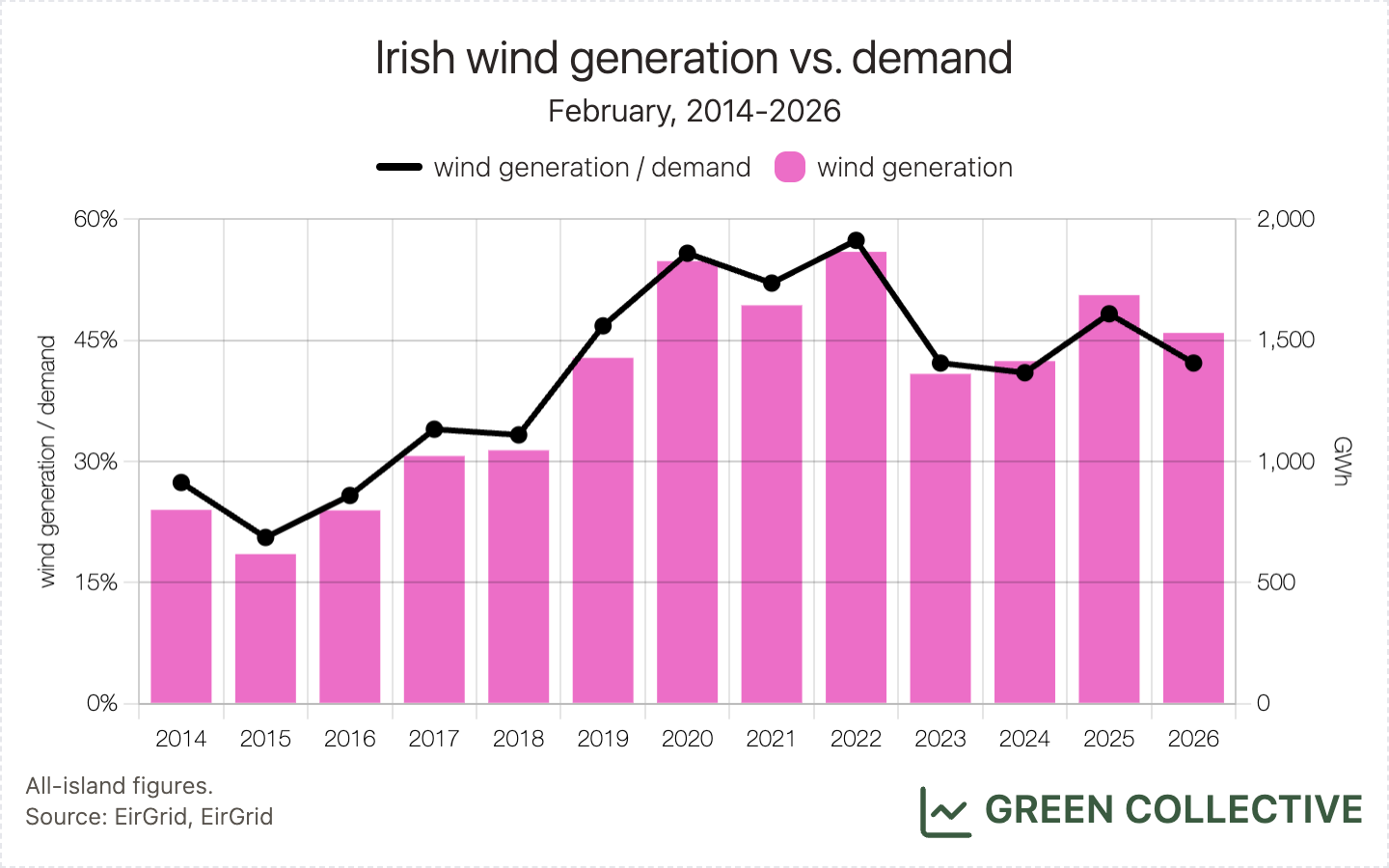
- Early in the evening of Saturday, February 14, the island recorded a new all-time record for wind output: 4686MW, equivalent to 72% of electricity demand at the time. After a wait of almost exactly two years, this is the third time this wind record has been broken so far this winter. While new records are welcome, their magnitude (as we noted in December) is growing much slower than wind capacity: this latest record is just 64MW more than December 2023's 4624MW; meanwhile, wind capacity grew by approximately 500MW during 2024 and 2025.
- Solar generation fell approximately 8% from February 2025, the latest such year-on-year fall reported here in recent months. This is still a little surprising given the new capacity coming online but we should bear in mind that winter is never going to be the best time for solar in Ireland.
- On the bright side, solar is already picking up: on February 28, output reached almost 650MW – equivalent to approximately 13% of the island's entire demand around noon. These were record numbers in the summer of 2024 which, less than two years later, we're now seeing in winter.
- 10.7GWh from discharging batteries was equivalent to 0.3% of the island's electricity demand, significantly down from January's 16.2GWh. Stronger wind generation in February means higher revenue potential in DS3 Programme, which explains less trading activity, hence less discharging batteries.
Folks who are interested in batteries should consider upgrading the subscription to gain access to our "Benchmarking Batteries" series!
County-level rankings
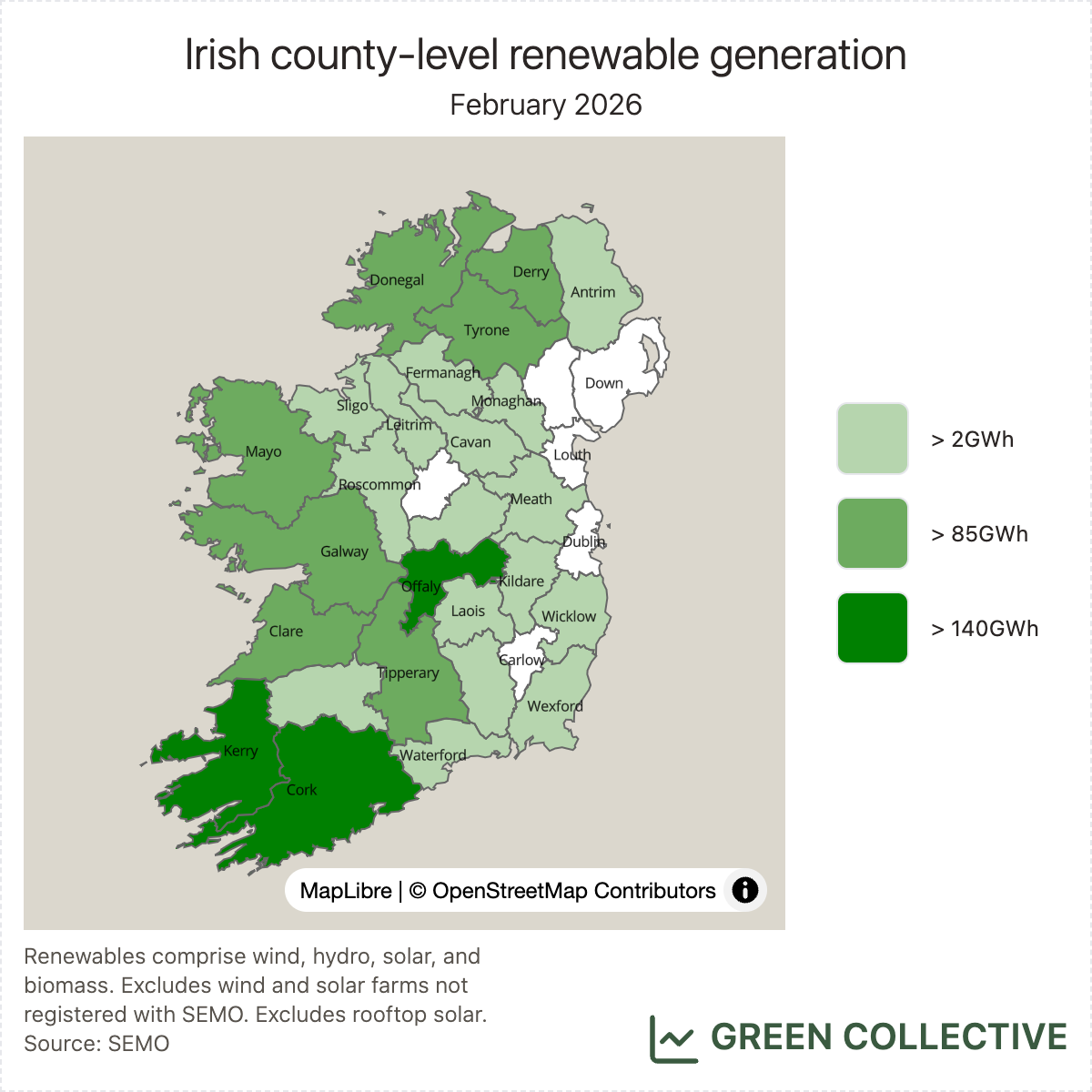
The top five renewable-producing counties during February 2026:
- Kerry
- Cork
- Offaly
- Clare
- Donegal
Clare is the real surprise here: home to several medium-sized wind farms, its promotion to the top five last month is entirely due to Ardnacrusha which, presumably thanks to winter rainfall, was the #2 renewable-producing plant (of any type) on the island during February, producing over 50GWh. This put it behind only Oweninny in County Mayo, the island's largest wind farm. Not bad as Ardnacrusha enters its second century of operation!
Fossil fuels and carbon emissions
- Fossil fuel generation totalled 1446.4GWh, or 39.9% of demand. Fossil fuel generation typically totals less than 50% of demand in February months (2023 is the only exception in recent years) but, following up on last month's newsletter, we can report that fossil fuel generation has now fulfilled less than 50% of demand every single month since August 2025.
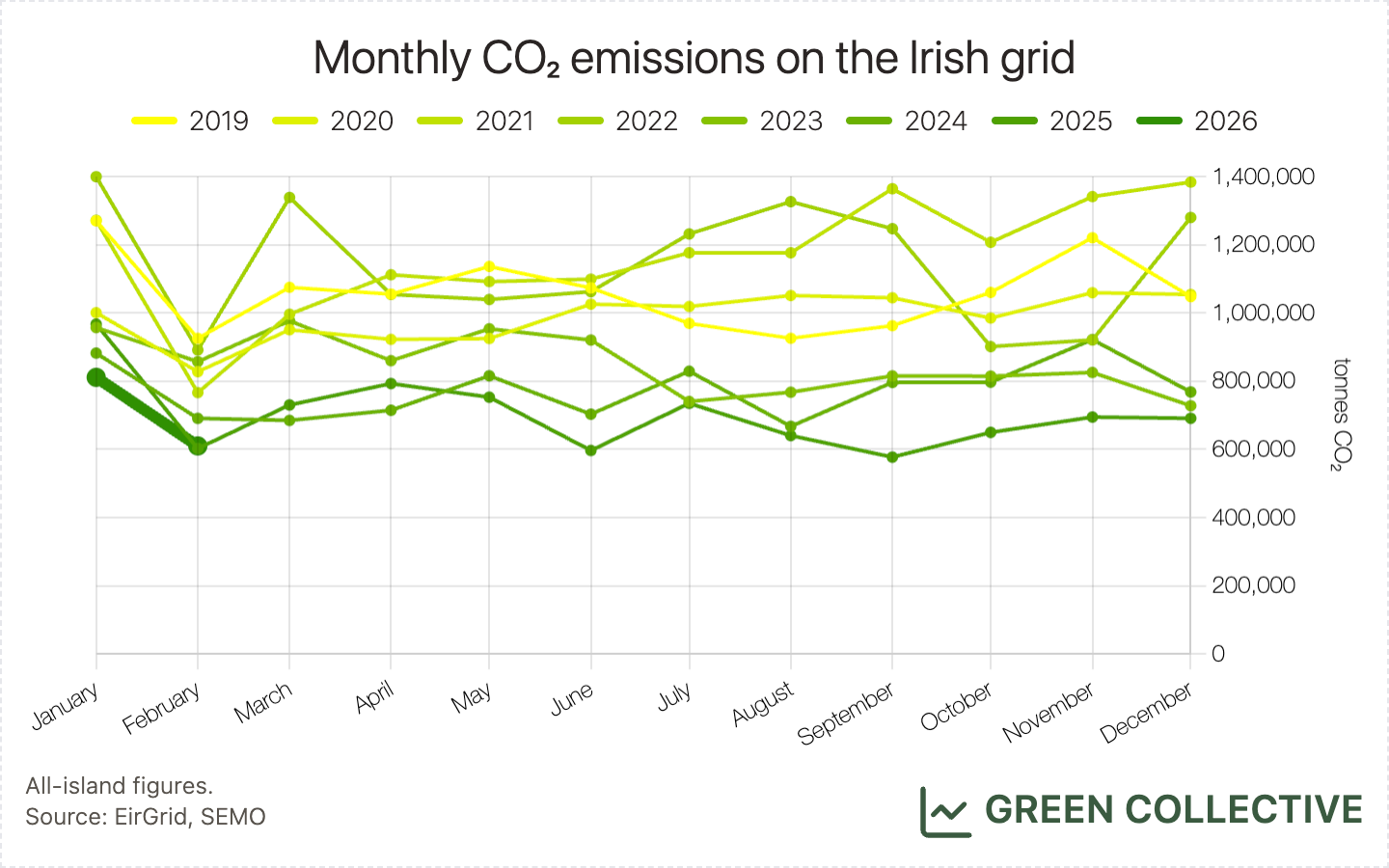
- We estimate that during February 2026 the Irish grid emitted approximately 610,000 tonnes of CO₂, ranging between 88g and 375g of CO₂ for each kWh of electricity generated for an average grid carbon intensity of 190gCO₂/KWh.
Something extra: more data transparency in large energy users demand
At the end of January, the Central Statistics Office (CSO) published hourly electricity consumption data of large energy users for the first time. We first heard about this new dataset via this post from Lee Carroll at the SEAI. As he pointed out, there is little variance in hourly demand. We added Green Collective's grid carbon intensity estimates on the chart below. While average grid carbon intensity doesn't vary greatly either, it fluctuates a lot more than large energy users demand.
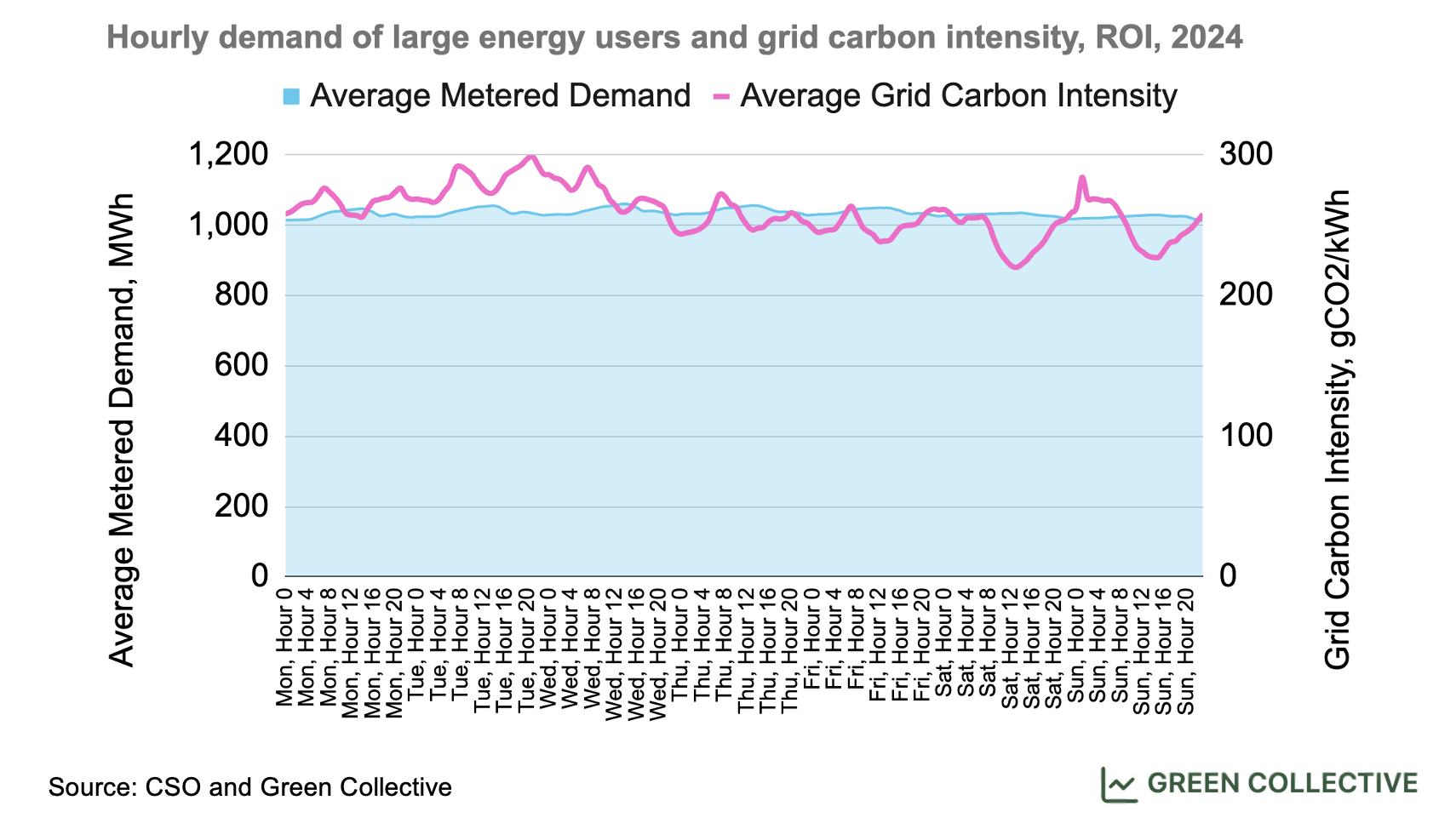
Data centre demand flexibility has been a hot topic over the last year, if not longer, but it's unclear whether the demand concentrated in Dublin/Meath actually has the potential to be flexible. For example, batch processes such as training AI models are far more amenable to pre-emption and/or re-scheduling than time-sensitive operations such as serving a dynamic website. While we suspect the former is likely comprise more of the total load in recent years, any estimate of the percentage of load that is easily re-schedule would be pure hand-waving. If you have any insights into this and would like to share with us, please send us a note at hello@greencollective.io.
Thanks for reading the free version of the Irish Grid Monthly! We delve into more details in Irish Grid Monthly Plus. If you are interested in more analysis and data visualisations, please consider upgrading your subscription and access all past and future issues here.