Irish Grid Monthly: August 2026
Hello! August 2026 wasn't a huge month for the Irish grid, at least compared to recent months – but we've rounded up our usual charts and stats to keep you up to date on what's happening. Behind the scenes, we're pleased to note that every county on the island now has some renewable generation capacity in the daily SEMO reports: Longford's Ballycore Solar Farm has already started exporting to the grid, while Louth's Monvallet Solar Farm (plus storage) has yet to export but has appeared as a registered unit – next summer, the littlest county (home to one of your authors) could very well sport the island's largest solar farm. Anyway, enjoy our August report and thank you as always for being a subscriber!
TL;DR
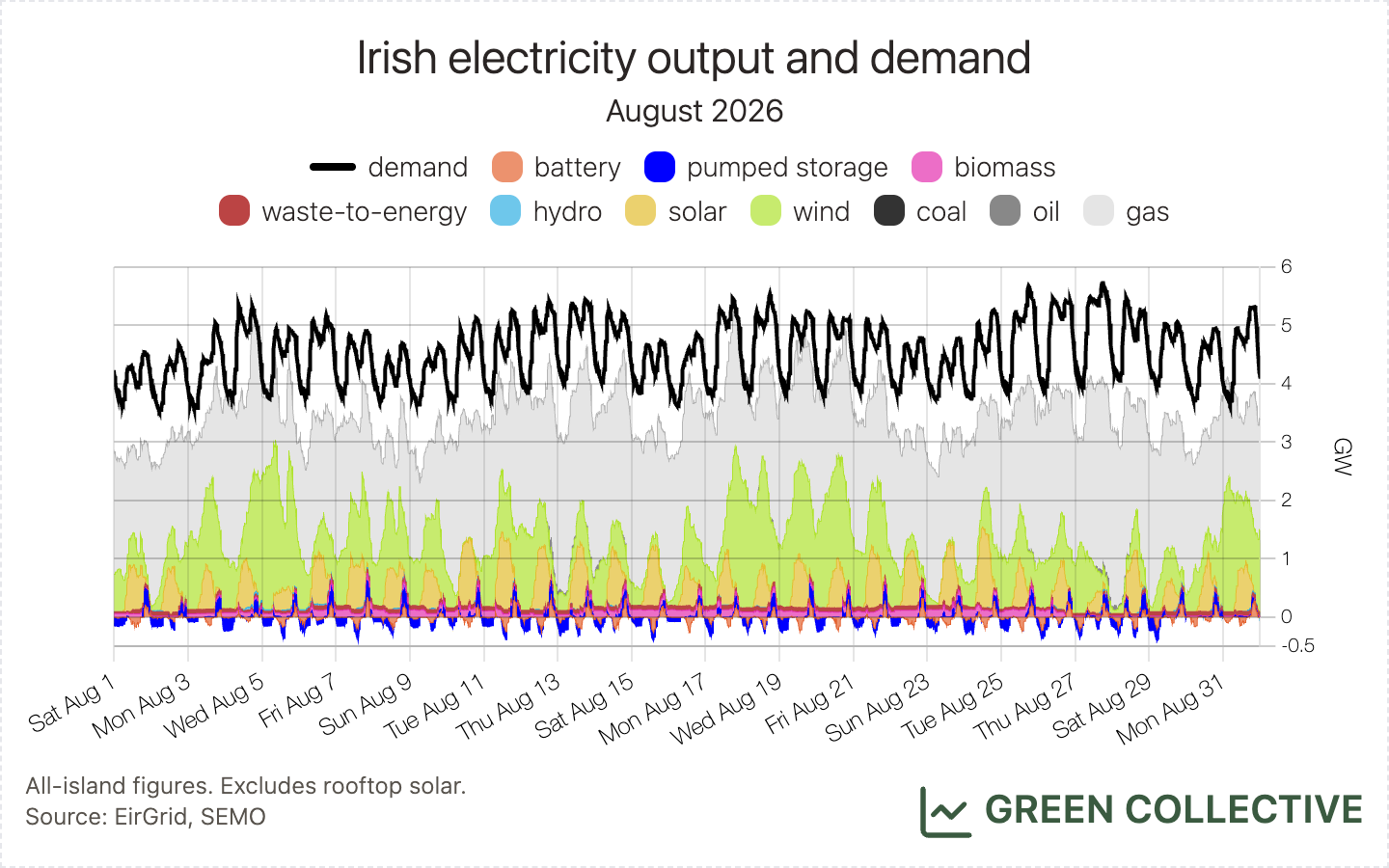
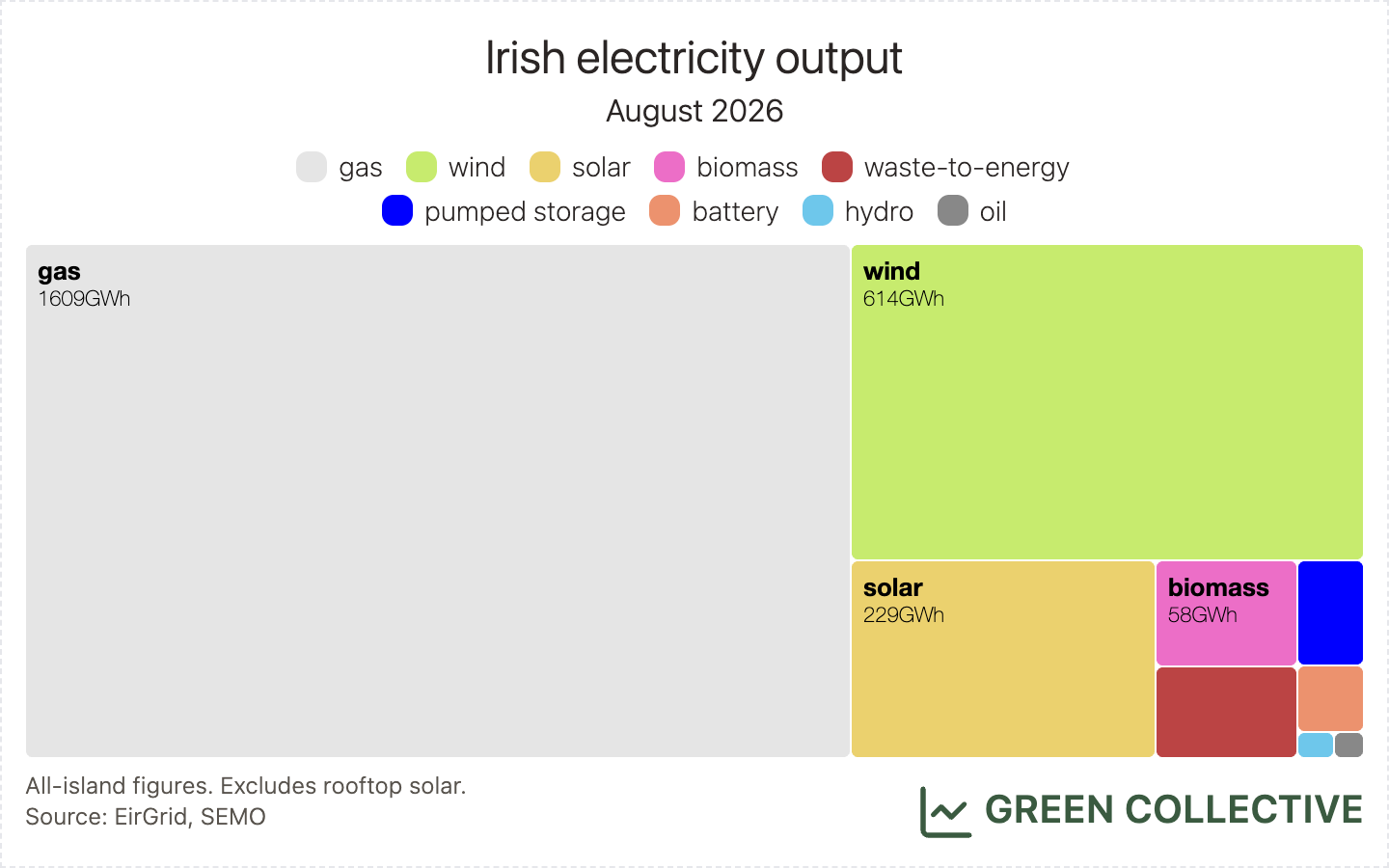
- The percentages of the island's electricity demand met by each source during August 2026:
- 26.7% renewables (18.2% wind, 6.8% solar, 0.1% hydro, 1.7% biomass)
- 49.2% fossil fuels (47.6% gas, 0.1% oil, 1.5% waste-to-energy)
- 1.3% storage (0.8% pumped storage, 0.5% batteries)
- 22.5% net imports
- Net imports totalled 762GWh, equal to 22.5% of electricity demand, both the highest ever figures for any calendar month.
- Winds were simply unusually low this August, which also led to low dispatch down rates: we estimate 12% of dispatch down in the Republic of Ireland and 16% in Northern Ireland.
- August was a wonderful month for Irish solar but the extraordinary three month-long record-breaking streak has ended as the days get shorter. However, we did see one notable high for solar: in the late morning of Monday, August 24, solar output reached 1380MW.
Emissions
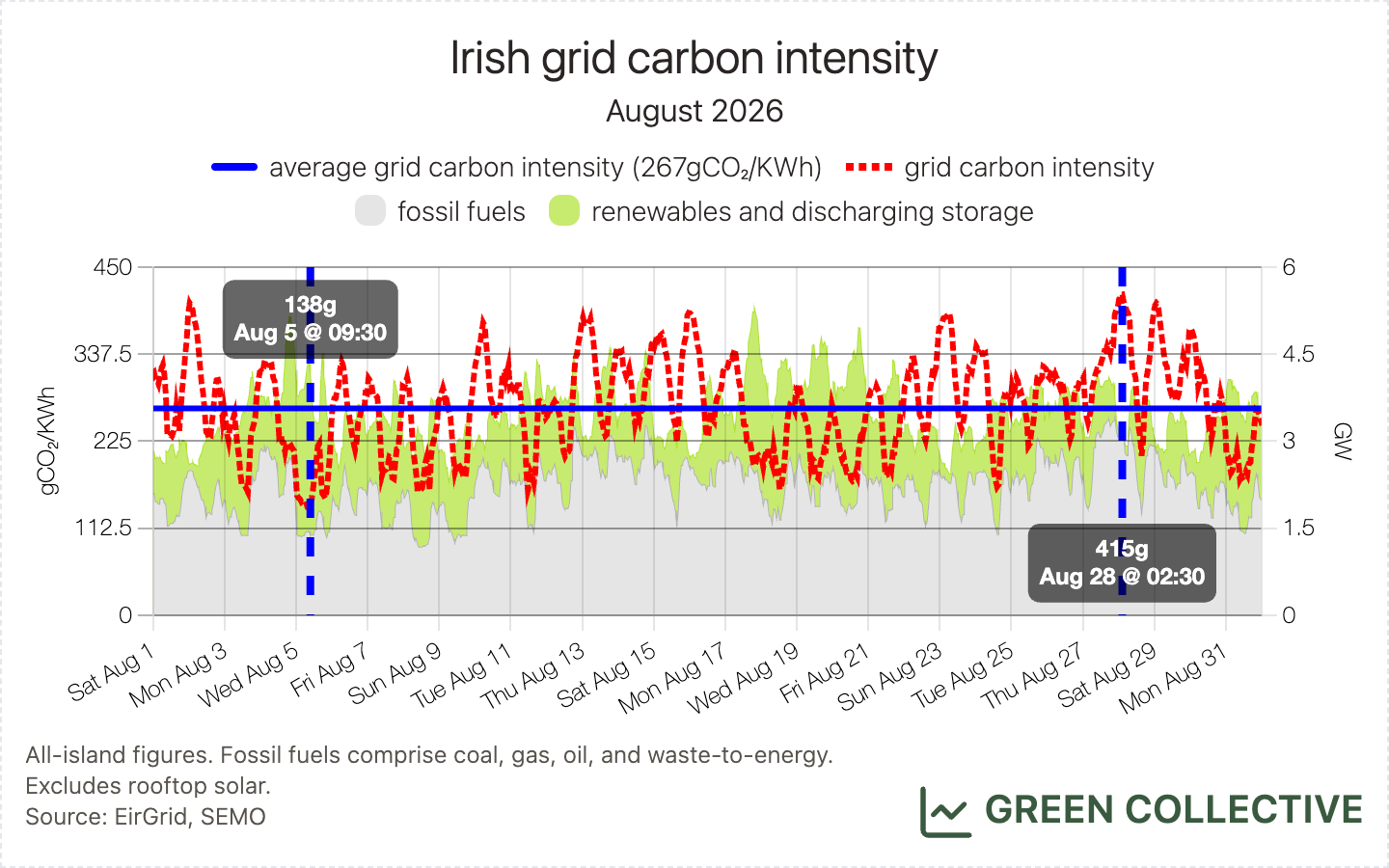
In August 2026 the Irish grid emitted approximately 702,000 tonnes of CO₂ ranging, for each kWh of electricity generated, between 138g and 415g of CO₂ for an average grid carbon intensity (GCI) of 267gCO₂/KWh.
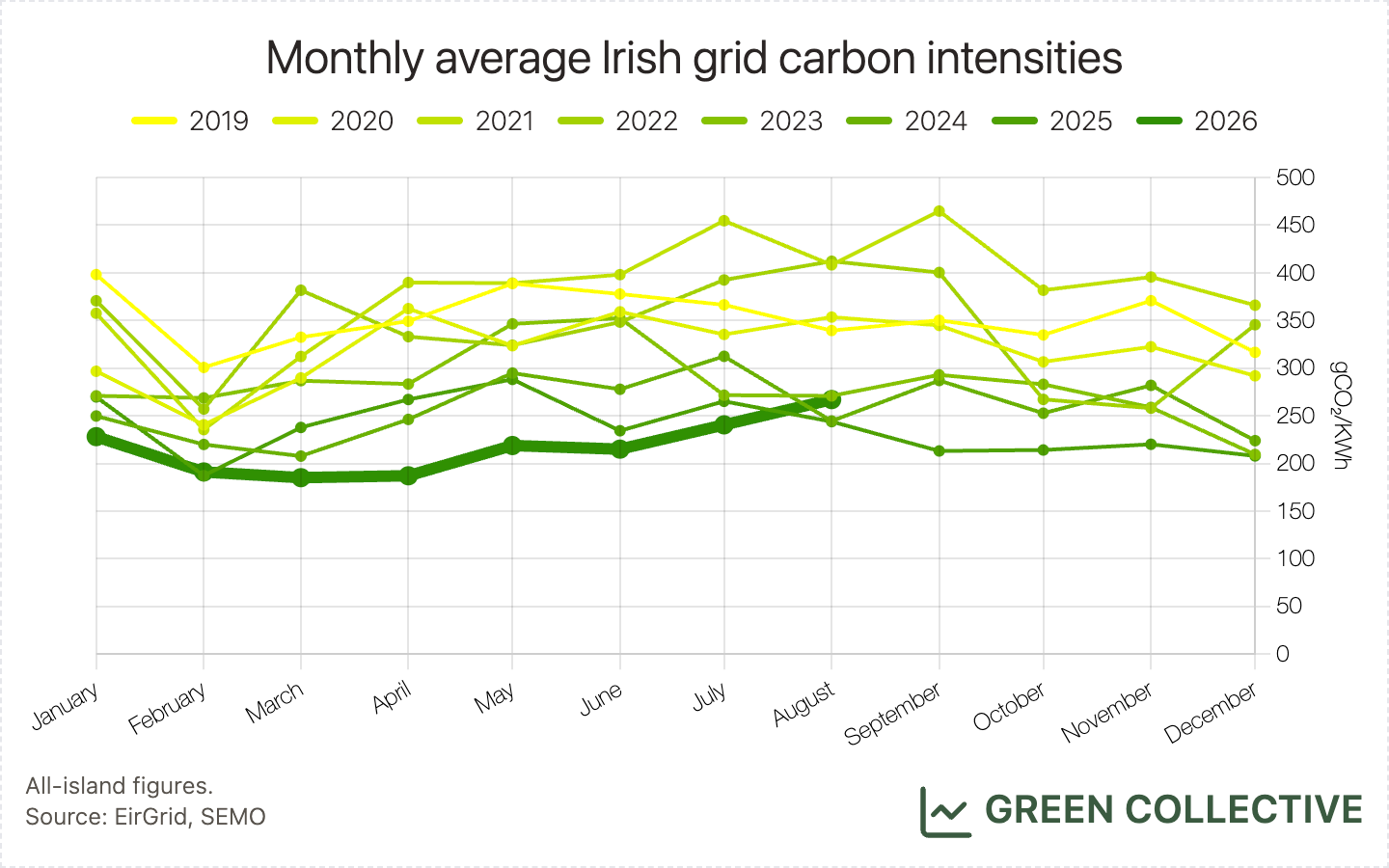
That's the highest average GCI for any month so far this year and the first month since February in which we haven't seen a new GCI record for that month of the year. However, it's not a major step backwards: August 2025 and August 2024 saw only slightly lower average GCI and CO₂ emissions (244gCO₂/KWh/640,000t and 245gCO₂/KWh/667,000t respectively) and last month's figures shouldn't massively impact the year's average CGI. That currently sits at 215gCO₂/KWh and in fact we're very likely to see 2026 finish with the lowest ever average annual GCI. Still, it's a surprising little blip given domestic generation last month was at its lowest for an August month since 2014.
County-level analysis
The top five renewable-producing counties in August 2026:
- Offaly
- Cork
- Galway
- Meath
- Kerry
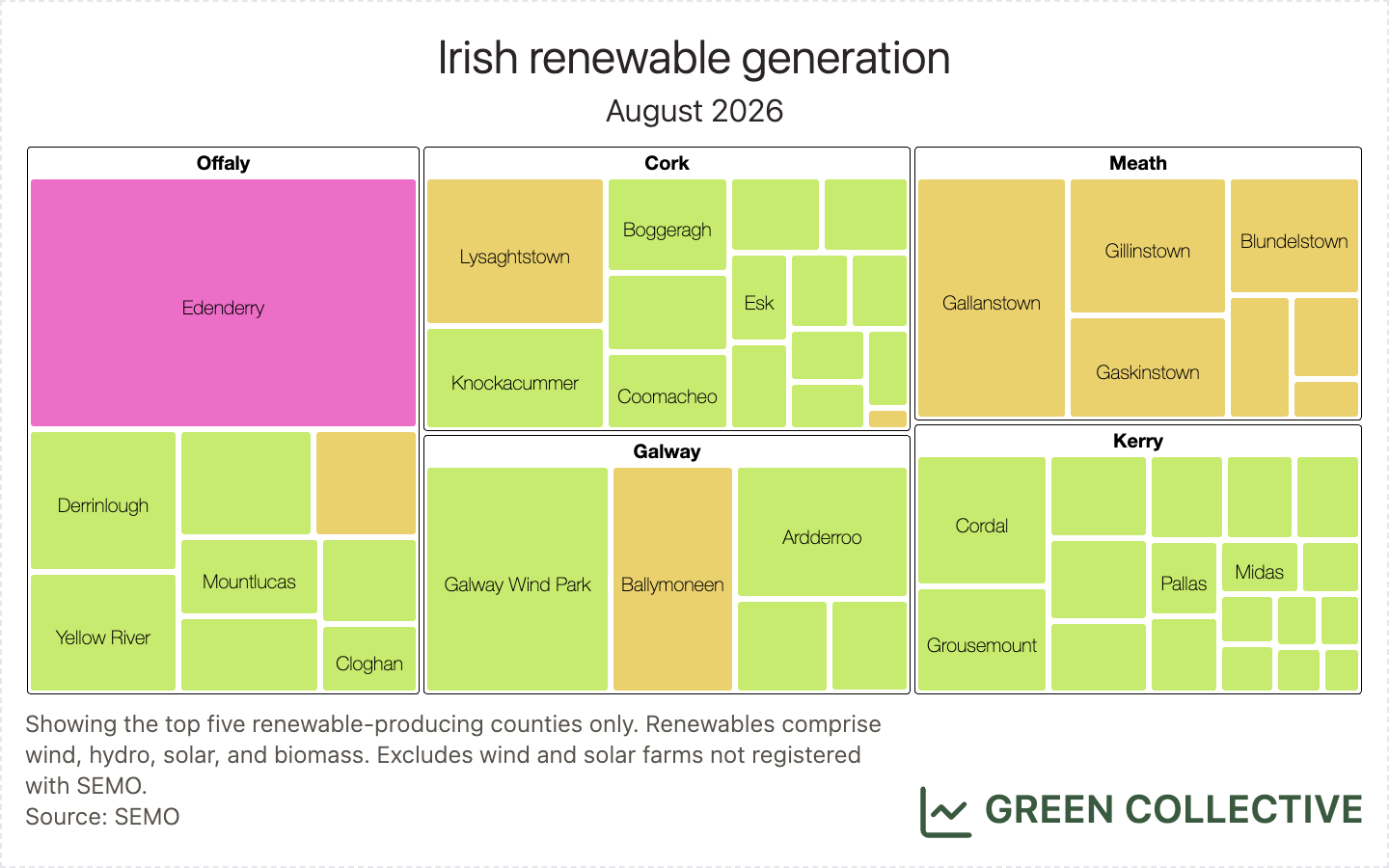
Offaly tops the table this month, and by some distance: it totalled almost 100GWh, over 50% more than any other county in the top five. How did it finish so far ahead? The biomass plant at Edenderry – offline for most of July – returned to normal output this month and, while winds are low and solar fades, it just keeps on burning.
Following July's upset, Cork and Kerry were top wind producers once more – but the real story, again, lies with solar: it put Cork well ahead of Kerry (we don't know why the new Drombeg Solar Farm there hasn't exported to the grid since June), kept Meath in the table for the second month in a row for the very first time, and placed Galway ahead of Meath (Galway's Ballmoneen is now the #2 solar farm on the island, having started peaking at 100MW during August).
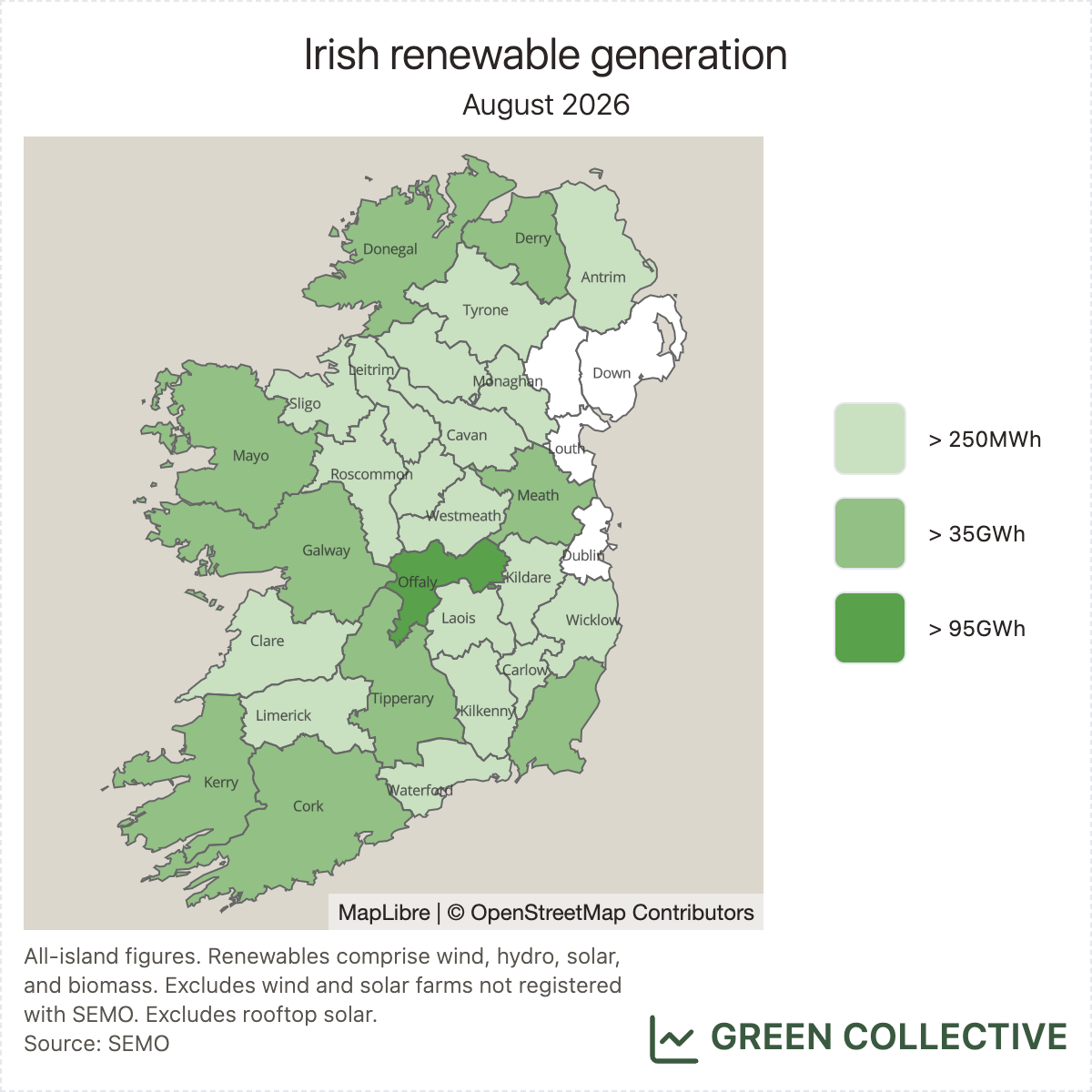
What if we exclude biomass, as we effectively did in July? Offaly would have dropped to #6 with Cork, Galway, Meath all moving up one position – and Derry would sneak in at #5. To illustrate the outsized effect of Edenderry this month, we've included a treemap below of the top five counties' renewable production.
Thank you for reading! The rest of the newsletter is available to paying subscribers only. We go into more details on our dispatch down estimates and point you to specific unit-level data that explains the trends we saw in August. You can upgrade to a paid subscription to access all our analysis.