Irish Grid Monthly: January 2026 + upcoming changes
Happy St. Brigid's Day! Before we dive into the January recap, we want to discuss some upcoming changes to this newsletter.
When we started this project back in 2020, the goal was to highlight the progress (or lack thereof, in some respects) of renewable energy on the island of Ireland. This is still among our main objectives but, at this point, various segments of our readership may need different types of content – and, we have to be honest, it takes a lot of time and energy to write all this!
As we continue to expand our coverage, we're fully aware the more detailed and wonky analyses (generally correlated with the number of acronyms in a post) are only of interest to some. In an effort to tailor our content to different audiences and make our work more sustainable, here are some upcoming changes starting March 1, 2026:
- Irish Grid Monthly: We will still be publishing a free monthly recap accessible for everyone that covers high-level generation and demand stats, commentary on trends, county-level rankings, carbon emissions, records on the grid, system-level wind and solar dispatch down estimates, etc. We'll try our best to keep the free version under 1,000 words.
- Irish Grid Monthly Plus: In addition to what’s covered in Irish Grid Monthly (free), the Plus version will go into more details, e.g. ad-hoc discussions on renewable auctions, explainers on how we estimate dispatch down levels and carbon emissions, spotlights of specific generating sources when analysing county-level trends, etc. If you find the current length just the right amount of babbling (or not enough), the Plus version may be more your speed.
- Other issues: So far, our reports outside of monthly and annual recaps have focused on grid-scale batteries with the Benchmarking Batteries series. We would like to produce more regular reports analysing other topics as well, e.g. more detailed coverage of dispatch down by location, the relationship between interconnectors and indigenous renewable generation, and wholesale prices trends, just to name a few (many thanks to those who filled out the recent reader survey and answered the question about what’s currently missing in our coverage).
Irish Grid Monthly will be accessible to all, while Irish Grid Monthly Plus and other content will be available to members with paid subscriptions, regardless of tier. We have been very touched by the fact that we have any paid members at all, despite them having received no bonus content yet.
Currently, we have a silver tier (€5/month, with a 20% discount for annual subscribers) and a gold tier (€10/month, also with a 20% discount for annual subscribers). As long as you have a paid membership, you will have access to all our issues – but we won’t mind if you would like to show extra appreciation by joining the gold tier. Many thanks for your support!
If you would like to upgrade your subscription in time for next month's newsletter, please follow the link below. If you are already a gold or silver member, thank you!
If you have any questions about these upcoming changes, feel free to contact us at hello@greencollective.io. Now, onto the January recap!
TL;DR
- Demand and share of renewables: Electricity demand on the island of Ireland exceeded 4TWh for the first time in a single month. Renewable generation equalled 38.5% of demand last month.
- Fossil fuel generation: Fossil fuel generation totalled less than 50% of electricity demand for the first time in a January month.
- Net imports: Net imports equalled 13.1% of electricity demand. This was the highest percentage of demand yet imported in a January month.
- Batteries: Discharging batteries is up 40% in January 2026 compared to December 2025, thanks to updates implemented to Scheduling and Dispatch Programme in November 2025.
- Carbon emissions: Carbon emissions and average grid carbon intensity reached an all-time low for a January month.
- County-level analysis: Offaly was the #1 renewable-producing county for the first time. This is the first time the top spot hasn't been occupied by either Cork or Kerry.
High-level stats
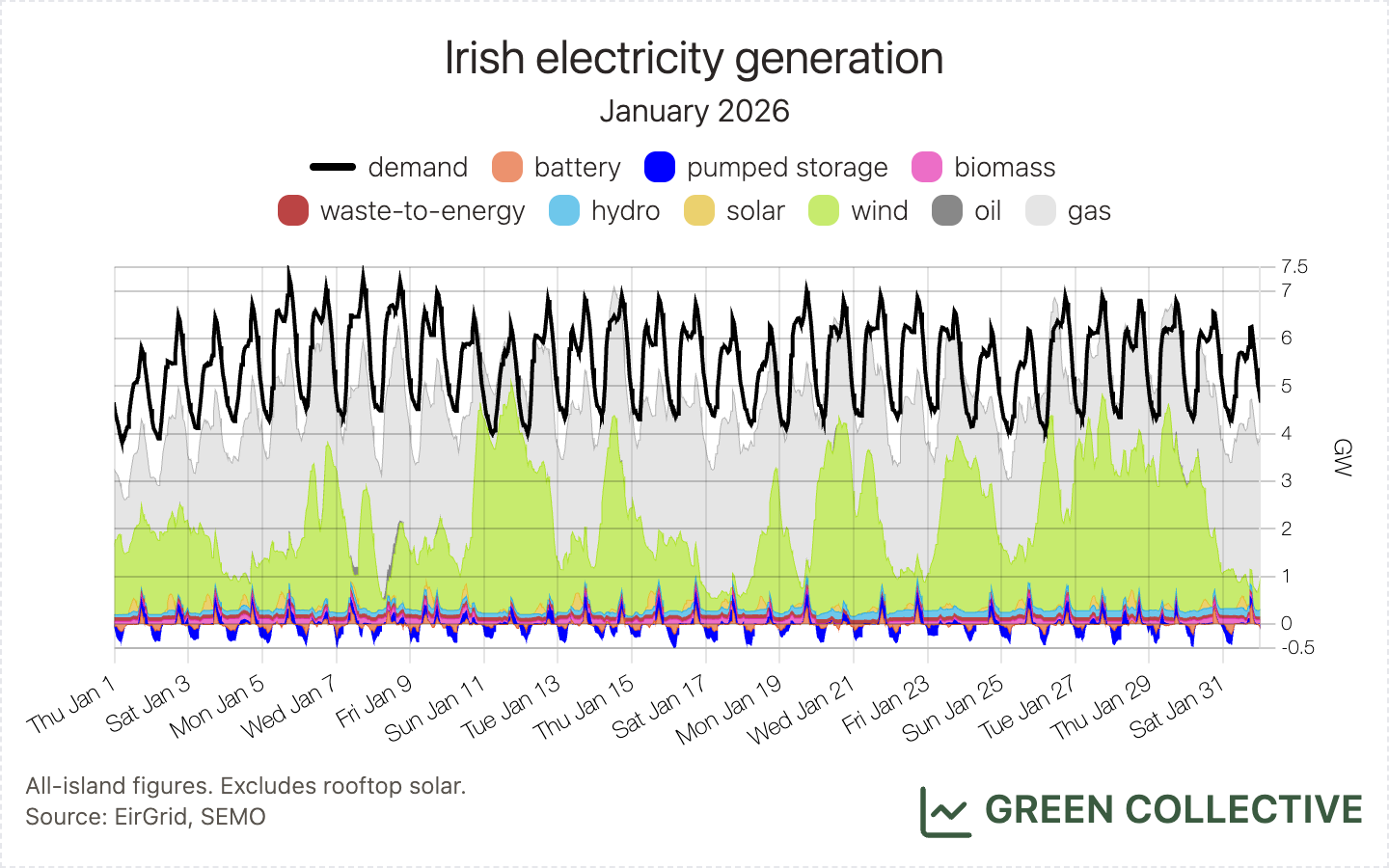
Electricity demand on the island of Ireland during January 2026 totalled 4087.9GWh, a 4.5% increase from January 2025. This was the highest electricity demand ever experienced in Ireland in a single month and it's the first time demand in a single month has exceeded 4TWh.
In Ireland, winter months typically see the most electricity demand due to increased heating in the colder weather: the #2 all-time high for monthly demand is January 2025, with 3.9TWh, and the rest of the top ten all range from November-March.
As for how that record demand was met:
- Renewable generation equalled 38.5% of demand.
- Fossil fuel generation equalled 47.1% of demand. This is the first time fossil fuel generation has totalled less than 50% of demand in a January month.
- Net imports equalled 13.1% of electricity demand. This was the highest percentage of demand yet imported in a January month and should come as no surprise since this is the first January in which the Greenlink interconnector has been fully operational.
Renewables
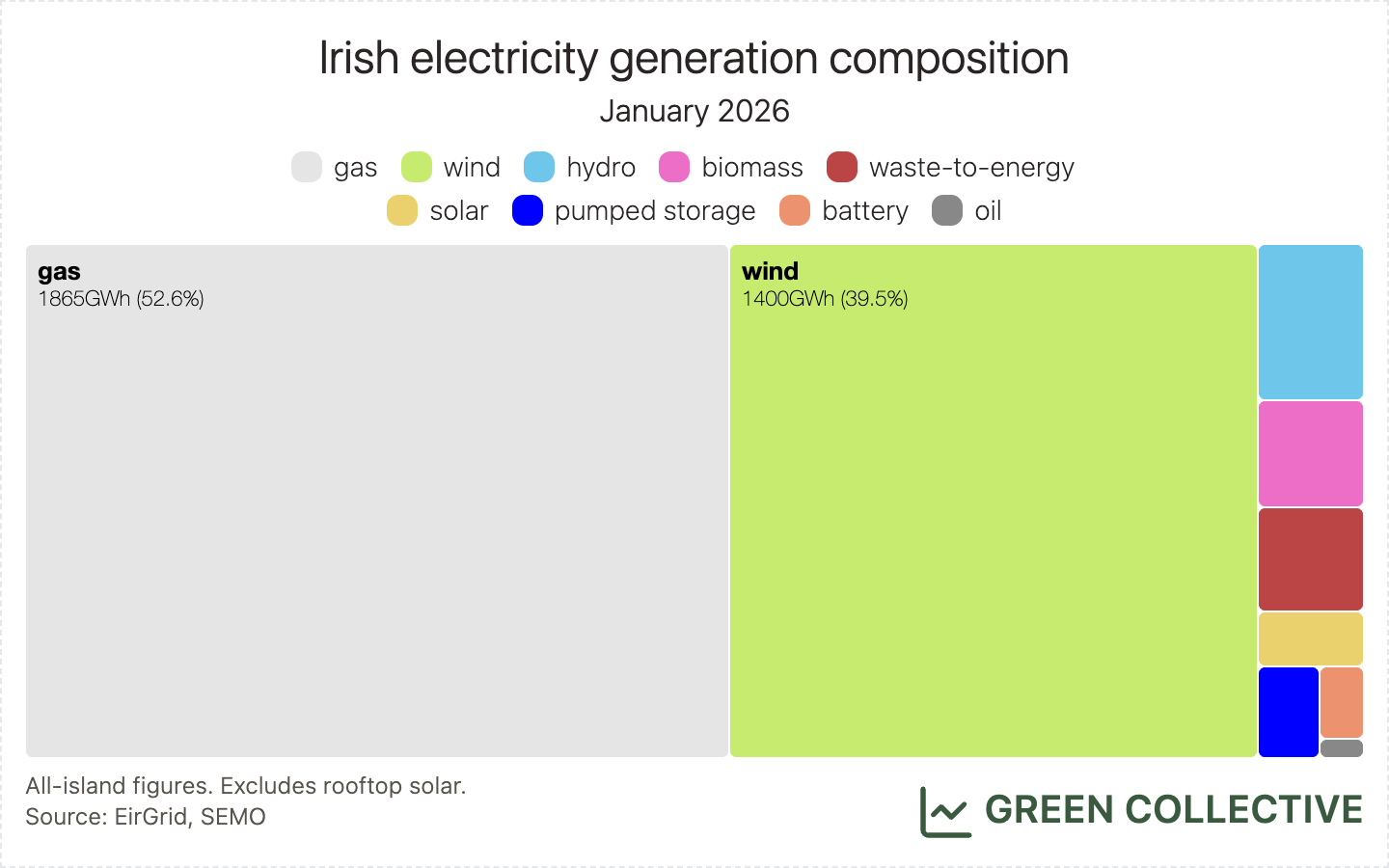
Renewable generation during January 2026 totalled 1575.6GWh, equivalent to 38.5% of demand. This was the second-highest total for renewable generation for a January month, behind only January 2023's 1609.4GWh. Due to rising demand, this was only renewables' fourth-highest share of demand in a January month.
A full breakdown of renewable generation:
- biomass: 59.3GWh / 1.4% of demand
- hydro: 85.6GWh / 2.1% of demand
- wind: 1400.5GWh / 34.3% of demand
- solar: 30.2GWh / 0.7% of demand
Regarding January's wind and solar:
- 1400.5GWh from wind farms was about average for a January month. While it was well up from January 2025's 1273.4GWh, we first saw 1.4TWh in a January month as long ago as 2018; January wind generation remains flat, at best.
- 30.2GWh from solar farms represents a rare year-on-year drop in generation vs. January 2025's 31.4GWh. The only other year-on-year monthly drop in solar generation in the last few years was in October 2025; while capacity did rise in 2025, the weather certainly was particularly poor this year and so we don't think this is necessarily the start of a new trend.
As mentioned at the top of this issue, we are making some changes to the newsletter, effective on March 1. You will still receive Irish Grid Monthly as a free member but those with a paid subscription will receive the more detailed Irish Grid Monthly Plus and other content. If you would like to make changes to your membership tier, you can use the link below. Thanks for your support!
Storage
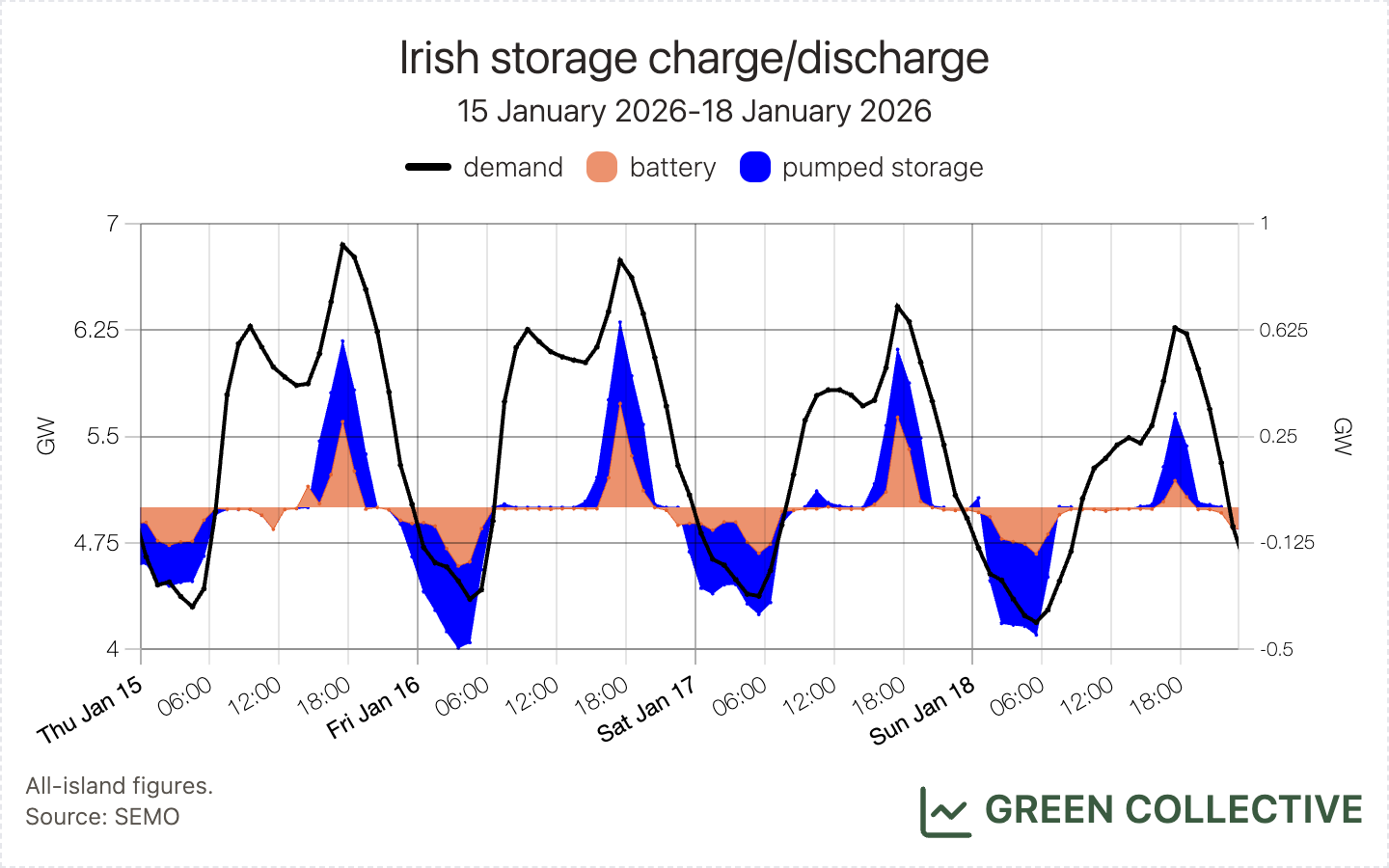
16.6GWh of battery discharge was by far the most of any single calendar month, up a whopping 40% month-on-month from December 2025's 11.9GWh.
Despite some important caveats (explained in detail in the most recent issue of our Benchmarking Batteries series), the fruits of the grid's new scheduling and dispatch programme launched during November are becoming clearer: discharge during the evening peak now regularly (10 days in January) exceeds 300MW unless wind generation is extremely strong. This is equivalent to roughly 5-6% of current winter evening peaks and means that batteries are finally starting to match Turlough Hill in terms of MW, if not (just yet) MWh.
Along with Turlough Hill, discharging storage met 46.2GWh or 1.1% of demand. That may seem small but if we restrict our figures to just peak evening demand (4-7pm), then discharging storage's share rises to roughly 4.5%.
Fossil fuels and carbon emissions
Fossil fuel generation totalled 1925.7GWh, or 47.1% of demand. Common in February for the past several years, this is the first time fossil fuels have equalled less than 50% of demand in a January month. In fact, fossil fuel generation has now fulfilled less than 50% of demand every single month since August 2025.
A full breakdown of fossil fuel generation:
- gas: 1864.7GWh / 45.6% of demand
- oil: 4.3GWh / 0.1% of demand
- waste-to-energy: 56.8GWh / 1.4% of demand
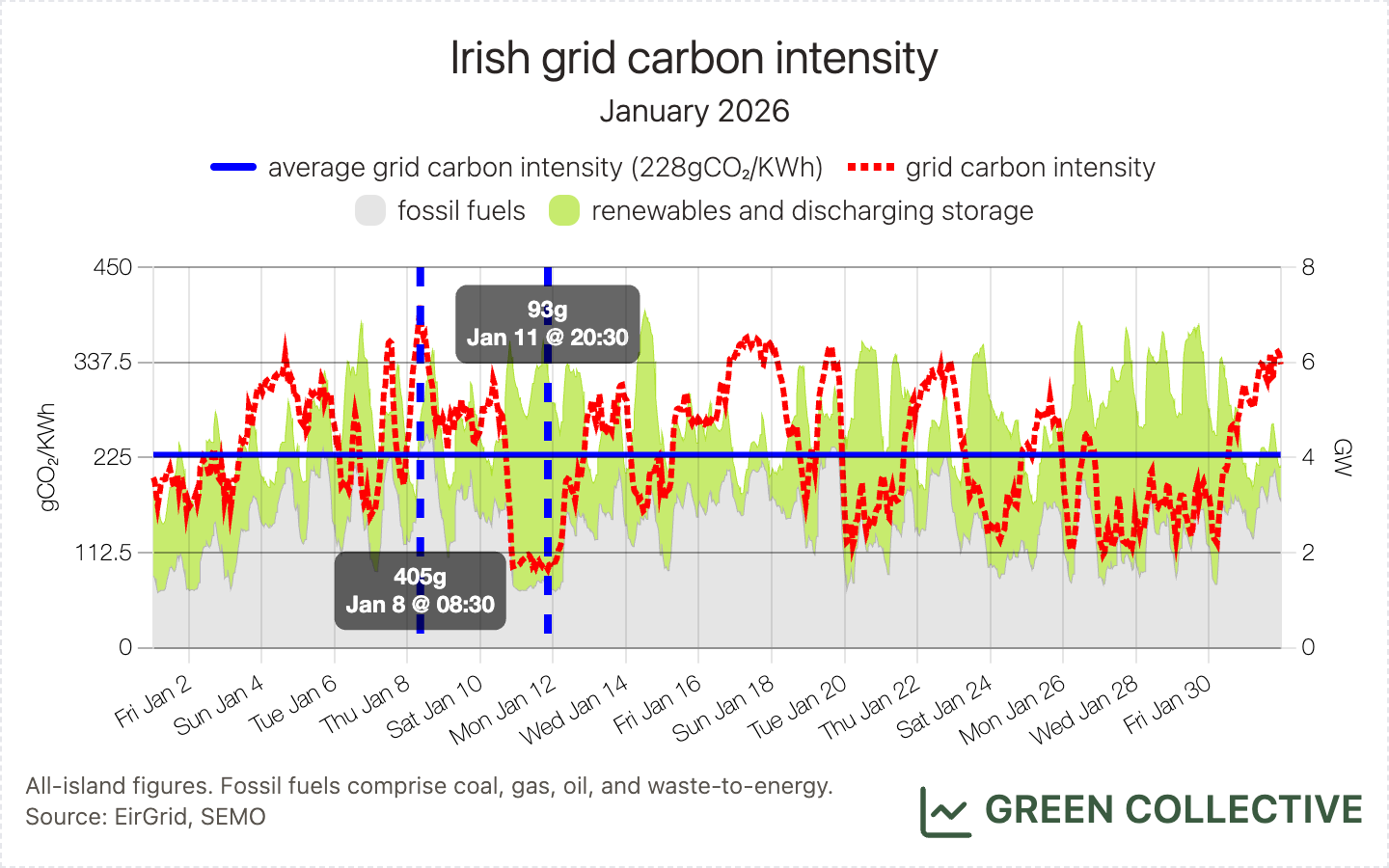
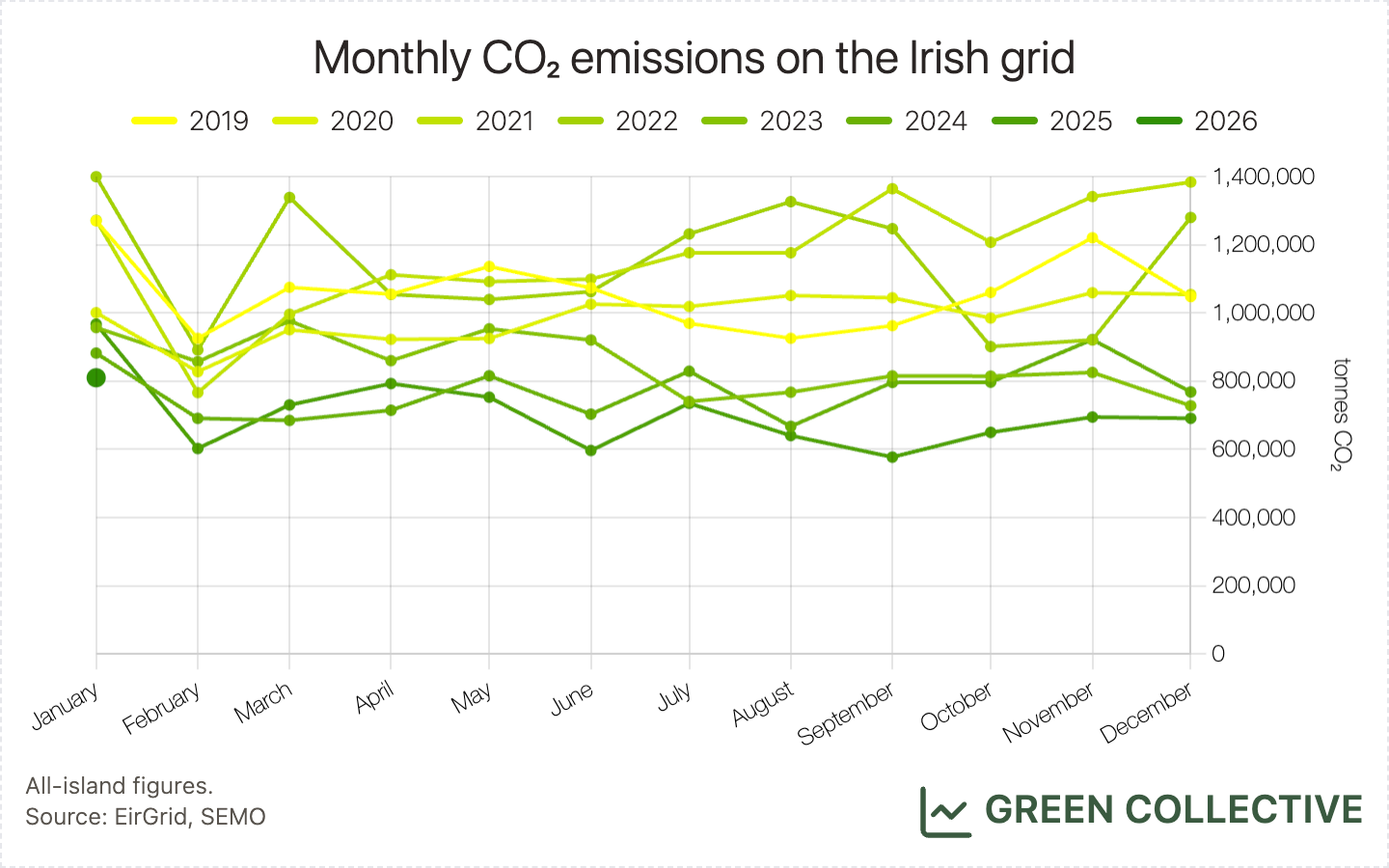
We estimate that during January 2026 the Irish grid emitted approximately 810,000 tonnes of CO₂, emitting between 93g and 405g of CO₂ for each kWh of electricity generated for an average grid carbon intensity of 228gCO₂/KWh.
This was both the lowest average grid carbon intensity and amount of CO₂ emitted in a January month. This is the sixth month in a row we've been able to report this in this newsletter: another impressive streak for the grid. How is this happening? This is the first winter without coal and, more significantly, the first winter with increased imports via Greenlink.
County-level rankings
The top five renewable-producing counties during January 2026 are:
- Offaly
- Cork
- Kerry
- Derry
- Donegal
This is the first time Offaly has produced the most electricity from renewable sources in a calendar month and it did so by a country mile, producing over 30% more electricity from renewable sources than the next closest county, Cork.
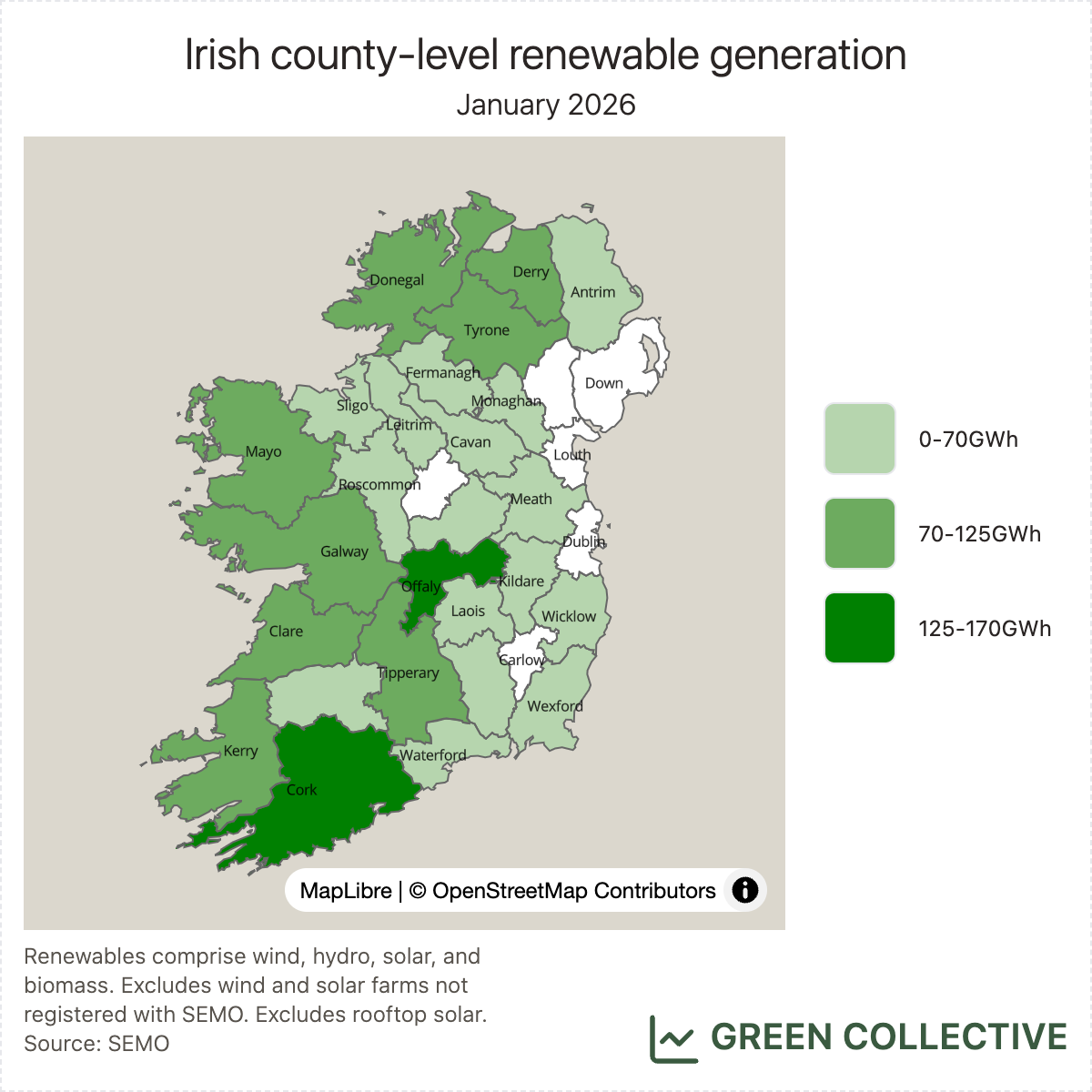
How is such a leap possible? At first, we suspected the biomass plant at Edenderry which, in theory, provides a continuous output of roughly 120MW – potentially more than even the largest wind farms on the island. In practice, however, Edenderry oscillates between 40-120MW and operated as usual during January. The answer was wind: for the very first time, Offaly was #1 wind producer. We crunched the numbers and while all of Offaly's wind farms were, for probably the first time, operating at full capacity all month-long, this doesn't fully explain the magnitude of the gap. However, on top of this, Cork and Kerry – until now always the two top wind producers – contributed much less to the overall renewable total last month, suggesting it was also simply (much) less windy than usual in the south. It will be very interesting to see what happens in February, typically the best month of the year for wind generation.
Last on counties for now: welcome to the game, Westmeath! Clonfad, Westmeath's first utility-scale solar farm, has started exporting to the grid. So far, it's been peaking at just 5MW but with a planned capacity of 175MW it's set to be one of the largest solar farms on the island.
With Westmeath lit up on our map, there are now just three counties remaining in which we don't track generation (of any kind – not just renewables): Longford, Carlow, and Louth. As always, please note that this doesn't necessarily mean those counties lack renewable generation: currently, we can only track generation at those plants participating in the market; this typically excludes the smaller plants, e.g. the solar farm at Beaulieu House in this writer's home county of Louth.
Hatches and Dispatches
- Erkina Solar Farm and extension have joined SEMO’s list of registered units in January 2026. These solar farms, totalling 156.6MW of maximum export capacity, were noted as contracted capacity with EirGrid since 2022. Located in Tipperary, the local county council granted Erkina Solar Farm planning permission in 2023. While we haven’t seen any generation exported from these sites yet, their presence in SEMO’s list indicates they are in the middle of or have finished their energisation process.
- The other new units joining SEMO’s list in January 2026 are Castlelost FlexGen located in Westmeath, hot on the heels of the energisation of Clonfad. The FlexGen uses gas and comprises 275MW of maximum export capacity. Similar to Erkina Solar, Castlelost FlexGen has also been on EirGrid’s contracted capacity list since 2022.
As mentioned at the top of this issue, we are making some changes to the newsletter, effective on March 1. You will still receive Irish Grid Monthly as a free member but those with a paid subscription will receive the more detailed Irish Grid Monthly Plus and other content. If you would like to make changes to your membership tier, you can use the link below. Thanks for your support!